
- Home
- About Us
- Chillers
- Industrial RO System
- Projects
- Exhibition
- Certificates
- Infrastructure
- Contact Us
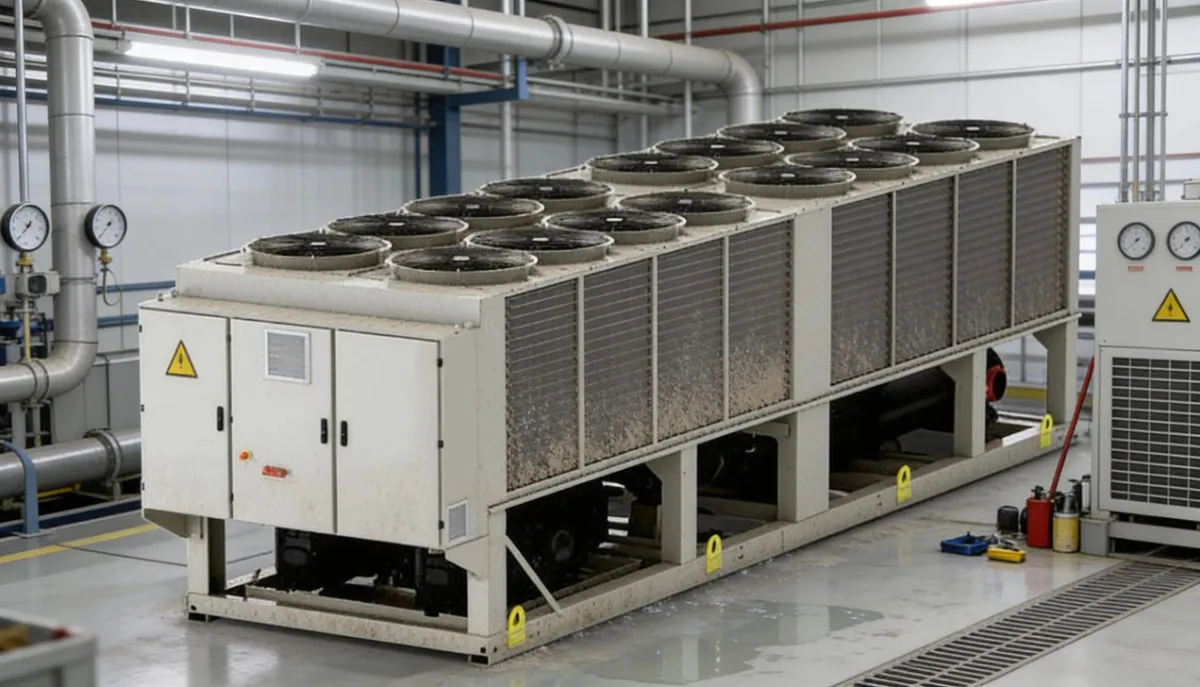
In heavy manufacturing and climate control, an industrial chiller is a core component responsible for cooling. Whether it is for cooling a laboratory for empirical characterizations or cooling machinery for factory production lines, the reliability of the equipment must be guaranteed. However, if maintained improperly, even good systems can eventually fail. While many times catastrophic failure occurs due to mechanical problems, many other times it occurs due to a long series of small, unnoticed maintenance issues.
One example of an overlooked maintenance issue is the water quality of the cooling tower system. Many times, facilities focus only on mechanical parts of the system while completely ignoring the fluid circulating through those parts. An example of this would be a water-cooled water chiller that relies on a constant flow of treated water in order to prevent buildup of scale and to prevent corrosion within the heat exchangers. If the chemical balance of the cooling water is not routinely tested and maintained, the chiller will eventually suffer from decreased heat-transferring capabilities and ultimately fail to operate.
People often think that normal tap water is good enough for cooling equipment. If your equipment isn't set up right and has the proper filtration in it, then the particulates dirt and minerals in the water will destroy your internal equipment. By adding an Industrial RO water Purification System to your facility’s infrastructure, you will proactively ensure that the water entering your cooling system is free of contaminants. Excess minerals create build-up fouling, and a thin layer of scale will act as an insulator, making your compressor have to work much harder as well as consume more energy than before to create the same cooling output.
The relationship between the way that water is treated and a cooling system can’t be stressed enough. Many companies are working with professional industrial RO system manufacturers in India to create an integrated solution to protect their thermal management assets. The longer the evaporator and condenser of your unit can be kept clean when using pure water, the longer they will last, and the less often you will have to make emergency repairs on your unit.
Trivia
Industrial chillers often fail due to small maintenance oversights rather than sudden mechanical breakdowns.
In most cases, air-cooled chillers will have maintenance problems with air flowing through the chiller. Since an air-cooled chiller uses outside air to reject heat, any obstructions to the condenser coils, such as dust, debris, or improperly placed items, can create high pressure on the condenser coils. As a result, the fans have to work against the dirty coils, causing an increase in electric consumption and the likelihood of having a high-pressure shutoff.
The consequences of not calibrating the sensors and thermostats can result in "short cycling" chiller operation. "Short cycling" occurs when the air-cooled chiller starts to turn on and off too frequently due to fluctuating temperature readings from the sensors. Frequent cycling of the chiller motor starters and compressor creates a large amount of wear and tear on the equipment, requiring more repair and replacement of parts. Checking electrical connections for integrity and verifying sensor calibration to maintain the liquid-cooled chiller requires disciplined work.
Trivia
Industrial RO systems help prevent mineral buildup, corrosion, and fouling in cooling systems.
Another critical error is to set the refrigerant charge once and forget about it: No leak detection system that trusts that there are literally only no leaks left will work because a pinhole leak can result in a loss of efficiency that occurs gradually, is largely unnoticed by operators, and is only realized when the system inevitably fails during a heatwave.
Besides refrigerant, the lubrication system is the lifeblood of a compressor. Oil analysis is one area that must not be ignored. Oil analysis can make bearing wear and moisture contamination visible even before there is a mechanical bearing failure. In a Water-Cooled Chiller, moisture in the oil is a red flag for a breach in the heat exchanger that allows water to interact with the refrigerant – a problem that often results in an expensive and tedious overhaul.
|
Maintenance Task |
Water-Cooled Systems |
Air-Cooled Systems |
Frequency |
|
Coil Cleaning |
Focus on Tube Descaling |
Focus on fin cleaning. |
Quarterly |
|
Water Treatment |
Critical (Scaling/Algae) |
Low Priority |
Monthly |
|
Fan Motor Lubrication |
Moderate |
High (Exposed to Elements) |
Bi-Annually |
|
Refrigerant Leak Test |
High Priority |
High Priority |
Annually |
|
Compressor Oil Analysis |
Essential |
Essential |
Annually |
Trivia
Water quality management is just as important as mechanical maintenance in water-cooled chillers.
As more and more industrial plants seek to manage their utilities in a whole-systems approach, plant managers are learning from their experiences with RO plant manufacturers in India that they can take waste from one part of the facility and use it as makeup water for their cooling system, as long as the necessary treatment cost is able to meet the standards set forth by the receiving facility. To do this requires a solid understanding of how to design an industrial RO water filter system specifically to accommodate the chemical properties associated with that type of output.
High-efficiency cooling also relies upon the consistency and dependability of the incoming water supply. Any changes in the incoming water pressure or temperature create instability in the cooling system, causing the system to have to seek out a stable operating paradigm, which creates an inefficient cooling operation. Because of this, many high-performing industrial plants are searching for Trusted Industrial RO Plant Manufacturers in India to provide them with the support and reliability to provide 24/7 operations of their industrial cooling system without interruptions.
Trivia
Modern industrial facilities often integrate RO-treated water systems to improve cooling consistency and reduce maintenance costs.
While the focus is often on heavy machinery, air conditioning chillers are also vital components in industrial settings, especially electronics manufacturing or pharmaceutical storage. Here, the precision of the air conditioning chiller is equally significant as its capacity. A slight drift in the temperature can spoil the whole batch of the product. Therefore, the maintenance of these systems must be clinical with hygiene and atmospheric control in mind.
Related Blogs You Might Be Interested In:
Top 5 Factors for Choosing Industrial Chillers in 2026 | Energy-Efficient
Aquatech is the best industrial water treatment provider. Also, we are the most trusted and reliable partner for many businesses. Since 2014 we have been providing solutions to many industries under the direction of Mr. Husain Shersiya. Our expertise is to provide the companies with high performance and customized solutions. We also offer RO plants and water softeners and many water purification technologies that are used in modern industries. Aqua Tech Plus focuses on customer satisfaction by providing end-to-end services, including consultation, installation, and maintenance. Also, we give sustainable solutions that meet the modern industrial demands. If you are thinking of sourcing a high-quality industrial water treatment system, then you are at the right place. We also serve cooling and heating solutions, commercial chillers, HVAC systems, and many other related products.
Maintenance is not a reactive approach to problems but a rigorous management approach based on data analysis to help prevent problems. Averting the common scenarios of ill water treatment, unserved airflow, and unattended sensor data will guarantee your cooling infrastructure remains the silent, reliable partner of your production process. The time invested today in routine checks prevents tomorrow’s massive costs resulting from unplanned downtime.
If you are looking for industrial water chillers, industrial RO systems, water treatment systems, water softeners, DM plants, UF systems, and other equipment, then we are the perfect fit for you.
Routine maintenance prevents unexpected breakdowns, improves cooling efficiency, reduces energy consumption, and extends equipment lifespan. Proper servicing also minimizes costly downtime in industrial processes where temperature control is essential for uninterrupted production.
Untreated water causes scale buildup, corrosion, and algae growth inside heat exchangers. These issues reduce heat transfer efficiency, increase compressor strain, and can lead to expensive repairs or complete system failure over time.
Industrial RO systems remove minerals, impurities, and contaminants from water before circulation. This protects chiller components from fouling, improves system efficiency, and reduces maintenance frequency while supporting long-term operational reliability.
Neglecting condenser coil cleaning, ignoring airflow obstructions, and failing to calibrate sensors can lead to short cycling, high-pressure shutdowns, increased power usage, and accelerated wear on compressors and fan motors.
Condenser coils should generally be inspected and cleaned quarterly. Water-cooled systems require tube descaling, while air-cooled systems need fin and debris cleaning to maintain proper heat rejection performance.
Even minor refrigerant leaks reduce cooling capacity and increase energy use. If left undetected, leaks can lead to compressor damage, emergency shutdowns, and expensive repairs during peak operational periods.
Oil analysis detects moisture contamination, wear particles, and lubrication issues early. This proactive measure helps prevent compressor failures and reveals internal system problems before catastrophic damage occurs.
Yes, inadequate filtration allows dirt and mineral deposits to accumulate within the system. This leads to fouling, reduced efficiency, higher energy bills, and premature component failure.