
- Home
- About Us
- Chillers
- Industrial RO System
- Projects
- Exhibition
- Certificates
- Infrastructure
- Contact Us
Aquatech Plus has the best Seawater Reverse Osmosis (SWRO) Systems that can be used to convert seawater into quality freshwater to be used in industrial, commercial and municipal facilities. As fresh water in coastal areas becomes much scarcer, SWRO can be easily used to supply a sustainable and energy saving approach to desalination. High-pressure pumps and high-quality semi-permeable membranes in our systems isolate salts, dissolved minerals, bacteria, and other impurities and provide safe and clean water to be used in a variety of applications.
Our SWRO plants are engineered to provide both durability and performance, which is achieved through the use of advanced pre-treatment filtration, energy-efficient pumps, and long-life membranes to provide the company with a steady output at lower costs of operation.
Get in touch with us and get the appropriate solution to your water treatment problem.
Freshwater scarcity is a growing challenge for the urban cities, industries and the communities across the world. Seawater reverse osmosis systems are increasingly becoming the solution more often to turn seawater into usable freshwater that is safe and is also energy efficient due to their reliability in terms of energy use.
Seawater reverse osmosis system (also known as SWRO) is a desalination process which extracts salt, dissolved minerals, bacteria and other impurities in seawater by means of high pressure pumps and semi-permeable membranes. The outcome is fresh drinking water of high quality that can be used in industrial activities and commercial purposes.
Modern seawater reverse osmosis plants are cost effective solution to the traditional thermal desalination processes and as such they are commonly implemented in municipalities, marine vessels, resorts, offshore facilities and even industrial processes.
The rising demand of new technology of desalination in India is attributed to the shortage of water in the coastal areas and the increasing levels of water to be used in industries. Reliable Seawater Reverse Osmosis System Suppliers in India are critical towards provision of effective systems that transform seawater into fresh and safe drinking water. A seawater reverse osmosis system involves the utilization of high-pressure pumps and semi-permeable membranes to extract the salts, minerals, and impurities of seawater. These are popular systems in industries, boats, resorts, offshore plants and even coastal cities with low freshwater supply.
Customized SWRO systems manufactured by professional suppliers are based on the particular water quality, capacity, and operating conditions. Reverse osmosis plants built in modern times are fitted with improved pre-treatment filtration, low consumption pumps, and filtration membranes that have durability so as to maintain consistent performance and prolonged service.
Key Highlights:
A sea water reverse osmosis system is a special desalination system that is used to extract high levels of salt in sea water. In contrast to the common filtration, the seawater reverse osmosis relies on the pressure and forces the water to be pushed through the semi-permeable membrane that prevents the entry of salt molecules and other impurities.
The process normally runs on pressure ranging between 55 to 70 bar as required in order to overcome the natural osmotic pressure of the seawater.
The main features of the contemporary seawater reverse osmosis systems consist of:
Due to these merits, SWRO is the desalination technique that is most popular in the world.
Knowing how SWRO desalination works would assist business people and managers of the facility to select the appropriate water treatment system.
The general steps of seawater reverse osmosis process mostly involve three steps.
The most common pre-treatment processes are:
These measures eliminate particles and decrease the chances of fouling prior to water getting to the main desalination stage.
During this stage:
This is the main operating principle of every seawater reverse osmosis system.
The steps taken after the treatment may include:
Such measures are done to make the water safe, stable, and fit to be drunk or used in industries.
All SWRO plants are composed of a few integrated elements which collaborate in order to accomplish effective desalination.
A combination of these elements makes a full reverse osmosis plant that can yield high quantities of freshwater.
Seawater reverse osmosis plants are applicable in numerous industries due to their flexibility as well as scalability.
Companies tend to need something more than a simple filtration system. They require commercial reverse osmosis systems with high capacity that have the ability to provide quality water on a regular basis.
A commercial reverse osmosis water filtration system is intended to be used continuously and at large scales to produce a lot of water. The common uses of these systems include:
The factors that need to be considered when choosing a reverse osmosis commercial system would include the capacity of the system, quality of the membrane, energy usage, and also the maintenance needs.
Businesses interested in obtaining the best commercial reverse osmosis system must pay attention to its reliability and cost of operation as well as its long-term performance besides purchase price.
A large desalination plant is not necessary in all businesses. Small commercial reverse osmosis systems are best suited to the facilities that have a medium water demand.
Common applications are:
These are small commercial reverse osmosis filter systems that are of high performance and have limited space of installation.
The seawater reverse osmosis system price is one of the most frequently asked questions by businesses.
The price will be determined by a number of factors:
When determining the commercial reverse osmosis system cost, companies can focus on the initial acquisition cost but also the operating cost which includes:
Properly developed system incorporating energy recovery technology can save a lot of money in the long term running costs.
India has become an important global hub for water treatment technologies, with numerous companies providing state of the art desalination technologies across the globe. Leading Seawater Reverse Osmosis System Exporters in India offers high-performance seawater reverse osmosis plants utilized to reverse seawater into freshwater to be used in a wide variety of applications. These system incorporates with high pressure pumps and special membranes to eliminate salts and contaminants and hence reliable production of freshwater at the coastal settings and sea environment.
To ensure the long term operation of the reverse osmosis plants, export quality plants are constructed using corrosion resistant material, modern filtration technologies and energy saving components. Indian exporters have a significant variety of solutions available, both small commercial reverse osmosis systems that may be installed aboard ships and resorts, and large desalination plants which are deployed in large municipal and industrial water supply projects.
Key Highlights:
When comparing commercial reverse osmosis system price, one should consider such performance measures as:
The superior systems can cost a little more in initial outlay, and can frequently take less operating cost and longer life.
Investment in the most suitable commercial reverse osmosis system will be more advantageous in the long-term view of many businesses.
In comparison with the conventional desalination processes, modern SWRO desalination technology has a various benefits.
Seawater reverse osmosis is very effective although environmental management is a key issue.
The primary issue of environment is brine discharge that contains concentrated salts extracted in the course of desalination.
The design of responsible systems comprise:
The modern reverse osmosis plants are also constructed in such a way that they have the least ecological impact but have a sustainable production of water.
There are a number of factors that should be considered carefully before the selection of the appropriate system:
The collaboration with the experienced seawater reverse osmosis systems manufacturers would provide the appropriate design of the system, installation, and maintenance.
The need of freshwater is ever-increasing and the seawater reverse osmosis systems have become very important to the supply of water sustainably. SWRO desalination systems offer a reliable alternative to municipalities, industries and commercial plants globally by transforming seawater into high quality fresh water.
The small commercial reverse osmosis systems all the way to large scale reverse osmosis plants, they provide a system that has dependable performance, is more energy efficient and even can scale up to a high level of water production.
Companies that want to use commercial reverse osmosis water filtration system should consider system capacity, efficiency, and long-run operating costs appropriately in order to invest in the best system to treat water.
| Model | Permeate Flow Rate (GPD) | Permeate Flow Rate (m³/day) | Permeate Flow Rate (m³/hr) | 8" Membranes (Qty) | Motor Rating HP @ 42,000 ppm (60 Hz) | Motor Rating HP @ 42,000 ppm (50 Hz) | Approx. Weight (lbs) | Dimensions (L × W × H) |
|---|---|---|---|---|---|---|---|---|
| FMSW-1 | 8,000 | 30 | 1.26 | 2 | 15 | 15 | 2,600 | 110 × 40 × 60 |
| FMSW-2 | 12,000 | 45 | 1.89 | 3 | 15 | 20 | 2,650 | 150 × 40 × 60 |
| FMSW-3 | 20,000 | 76 | 3.15 | 5 | 25 | 25 | 3,000 | 225 × 50 × 75 |
| FMSW-4 | 24,000 | 91 | 3.78 | 6 | 30 | 30 | 3,200 | 150 × 40 × 60 |
| FMSW-5 | 32,000 | 121 | 5.04 | 8 | 40 | 40 | 4,200 | 195 × 50 × 70 |
| FMSW-7 | 48,000 | 182 | 7.56 | 12 | 40 | 50 | 5,600 | 280 × 60 × 75 |
| FMSW-10 | 64,000 | 242 | 10.08 | 16 | 60 | 60 | 6,500 | 195 × 60 × 75 |
| FMSW-15 | 96,000 | 363 | 15.12 | 24 | 75 | 75 | 13,000 | 280 × 65 × 75 |
| FMSW-18 | 120,000 | 454 | 18.9 | 30 | 100 | 100 | 14,000 | 280 × 70 × 90 |
| FMSW-22 | 144,000 | 545 | 22.68 | 36 | 125 | 125 | 15,000 | 280 × 80 × 75 |
| FMSW-26 | 168,000 | 636 | 26.46 | 42 | 125 | 125 | 16,000 | 325 × 80 × 85 |
| FMSW-30 | 196,000 | 742 | 30.86 | 49 | 150 | 150 | 16,500 | 325 × 80 × 85 |
| FMSW-35 | 224,000 | 848 | 35.26 | 56 | 200 | 200 | 17,000 | 325 × 80 × 85 |
| FMSW-40 | 252,000 | 954 | 39.66 | 63 | 200 | 200 | 18,000 | 325 × 80 × 90 |
| FMSW-52 | 336,000 | 1,272 | 52.87 | 84 | 250 | 250 | 20,000 | 325 × 80 × 100 |
| FMSW-66 | 420,000 | 1,590 | 66.14 | 105 | 300 | 300 | 21,200 | 325 × 80 × 100 |
| FMSW-80 | 504,000 | 1,908 | 79.42 | 126 | 350 | 350 | 22,000 | 425 × 188 × 110 |
| FMSW-105 | 672,000 | 2,544 | 105.83 | 168 | 500 | 500 | 30,000 | 425 × 200 × 110 |
| FMSW-132 | 840,000 | 3,179 | 132.29 | 210 | 600 | 600 | 35,000 | 425 × 250 × 110 |
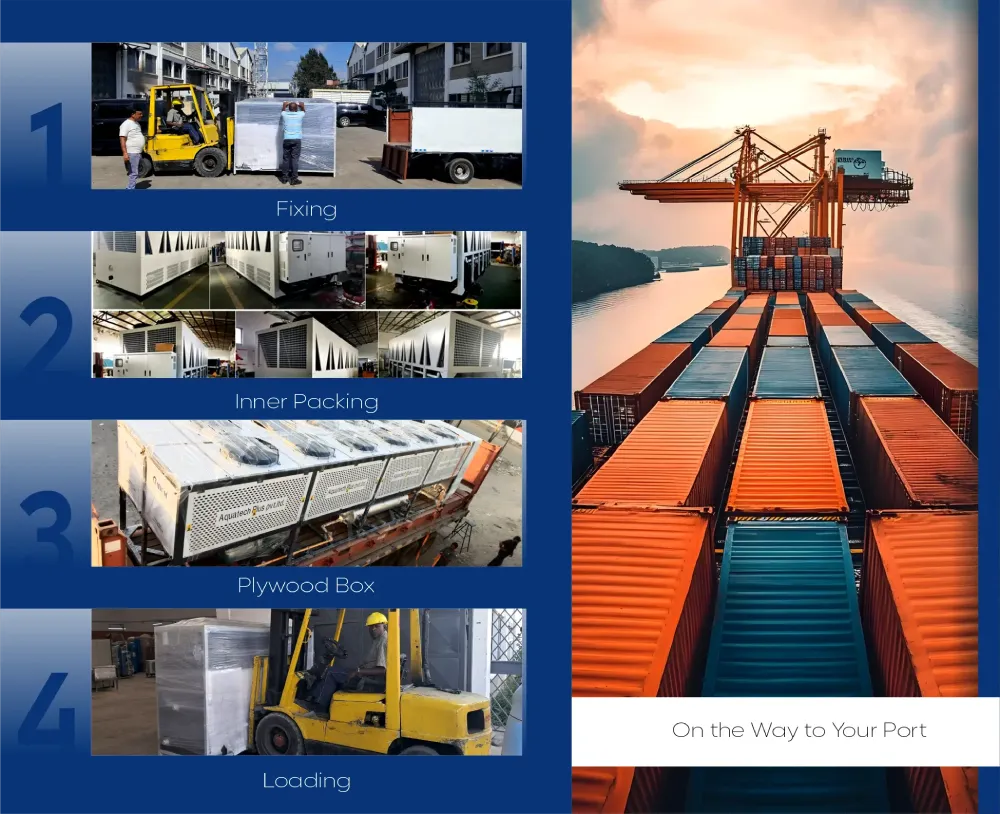
We have a uniform workflow in packaging and logistics that is export-wise, which prepares all our products except that they are safe in handling and delivery with no damages in India and other countries. Every phase is also thought out to cushion equipment against vibration, impact, and moisture risks in addition to long-distance transportation risks. The same is done to water chillers, air chillers and all other products that we produce and supply.
The process starts with mechanical repair of the unit of the product. The industrial quality fastening is used in all internal assemblies, critical parts, piping, and electrical parts. Moving components are fixed, and vibration-sensitive sites are fixed to avoid the mechanical stress during the transportation.
Objective: Avoid internal movement, vibration breakage, and alignments during transportation.
Once the repair is done the product is inner-packed with moisture-proof and shock absorbing materials. Foam padding, stretch film and cushioning materials are used as protective layers to cover all the exposed areas and all those components which are sensitive.
Objective: Dust, humidity, surface abrasion, and small mechanical shocks.
The product is packed in a specially designed heavy-duty plyboard box which is produced depending on its size and weight. The casing of the plywood is strengthened to resist the weights of the stacking, forklift operation and the transportation strain over long distances. When exporting goods, the packing is done to comply with the shipping and container loading requirements by the international community.
Objective: Optimal security on the outside and the requirements of the domestic and export logistics.
The product is loaded to the trucks with the use of cranes or forklifts, in accordance with good lifting and load-sharing practices. The delivery is then by road under conditions of control. In the case of domestic clients, the truck will go straight to the facility of the customer.
Objective: Loading and stable transportation on the road.
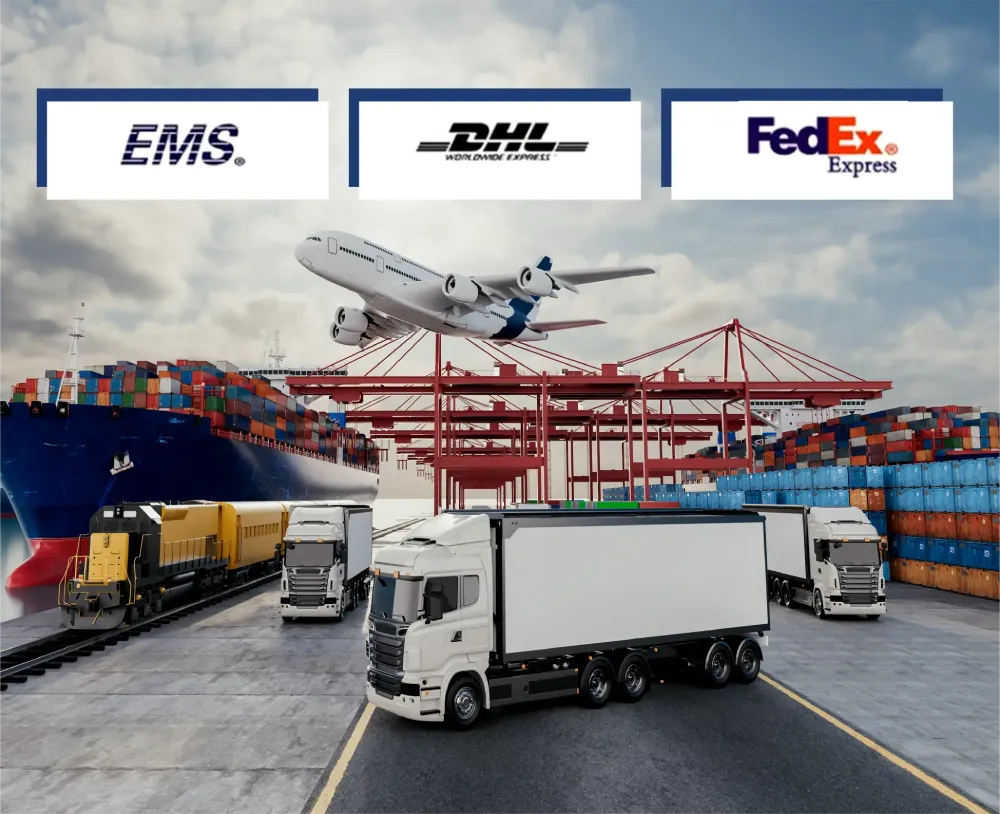
Whereas in international deliveries, the shipment is taken out of our plant to the Indian port. Pre-port entry All the export documentation, labeling and compliance checks are done before port entry.
Our logistics partners are reputable and trusted individuals like EMS, DHL Express, and FedEx Express who help us to have an easy time moving the ports and handling the exports.
Goal: The port handling and export preparation are smooth.
After clearance in the port, the product is delivered through sea freight into the destination port of the client. The packaging is to maintain a long transit period, container handling and a fluctuating weather pattern.
The international deliveries are also arranged with the help of the existing world logistics systems, the EMS, DHL Express and FedEx Express, which guarantee the safe and timely delivery.
Purpose: Achieve international delivery with low levels of transits.
A clear packaging and transportation procedure would assure that all products will be delivered to the clients in working conditions, lessen installation and commission problems, minimize the risk of transit damage, and facilitate hassle-free domestic and foreign delivery.
This is our standard operating procedure and is used in the process of packaging and transportation of all our products. Although the central process is the same, a different method can be used to pack the products, depending on the product size, weight and the destination to which the product is to be shipped.
This packaging and transportation workflow represents our standard operating process and is uniformly followed across our entire product range. The steps outlined above are not product-specific but define our company-wide logistics and export handling standards.
To maintain consistency, safety, and compliance, this process is intentionally displayed across all relevant product pages under the Packaging & Transportation section. While the framework remains the same, actual packing materials, box dimensions, and handling methods may vary depending on product size, weight, and shipment destination.
From an operational standpoint, this approach ensures:
From an SEO and documentation perspective, this section is used to clearly communicate our established logistics protocol, not to repeat marketing content. Each product page focuses on its unique specifications and applications, while this section defines our common logistics standards.

Algae, bacterial, mineral and organic membrane fouling of seawater reduces flow and salt rejection (usually less than 99 percent). It is a result of bad pre-treatment such as bad sand filtration or chemical dosing.
Obstructed pre-filters, damaged membranes, low inlet pressure, or malfunctioning storage tanks decelerate the production and filling of the tanks. This is aggravated by cold seawater or airloes in beach systems.
Expired carbon filters, clogged membranes or bacteria can pass through and raise the TDS and lead to off-flavors. It is solved by regular replacement of membranes (after every 2-3 years) and sanitization.
Pumps that malfunction under high pressure (55-70 bar) do not operate with energy recovery means; they become clogged, and the consumption of power grows by 20-50 percent. Install ERDs such as turbines and optimize pretreatment to reduce costs.
Seawater containing high salinity is toxic to marine organisms unless it is diluted or diffused, and causes regulatory problems. Sustainable disposal through the use of controlled outfalls and monitoring.
We carry a specified warranty and effective after sales services to all goods provided by us. Our warranty and service system will be aimed at long-term performance, reliability in terms of work, and peace of mind of our clients, both domestic and international.
Every product has a standard warranty of manufacturing defects dating back to the dispatch date or the date of installation, as existing. The warranty includes the defects to the quality of material and workmanship in the normal operation condition.
There are various warranty terms based on the product category, model, application and environment of use. Specifics on warranty period and coverage are provided in detail during the confirmation of orders or issue of invoice.
Warranty is not applicable on damages caused by:
Our technical support provides our clients with instructions on how to install, answer technical questions as well as basic troubleshooting. Depending on where the project is located, support is accomplished by providing documentation, remote assistance or by organizing services with service partners.
We assist both domestic and foreign clients with well-organized contact and export documentation. In the case of international customers, technical support and service management are offered remotely to have a comfortable functioning and prompt problem resolution.
There is a process in which service requests are processed. When we get a support request, we examine the problem and determine the warranty eligibility and suggest a remedy. The response timelines can be different depending on the product, location and availability of the components.
The above warranty and support terms are the standard policy which we use in our whole product line. Particular product-level warranty information might vary and are provided independently when taking orders.
This Warranty & Support section represents our standard company-wide policy and is consistently applied across our complete product range. The content is intentionally displayed on multiple product pages to communicate uniform warranty coverage, service terms, and support procedures.
While the core policy remains the same, actual warranty duration, coverage scope, and service conditions may vary by product model, application, and operating environment. Product-specific warranty details are shared separately at the time of order confirmation or documentation.