- Home
- About Us
- Chillers
- Industrial RO System
- Projects
- Exhibition
- Certificates
- Infrastructure
- Contact Us
Aquatech Plus is a reputable Containerized Water Treatment Systems Manufacturer in India, and provider of advanced and mobile water purification systems to the industries, communities, and infrastructural projects. Our systems are constructed within standard ISO shipping containers, resulting in fully integrated and plug and play treatment plants that can be transported and installed anywhere easily.
In every containerized system, there is the combination of the modern technologies like Reverse Osmosis (RO), UV disinfection, carbon filtration, sediment filtration and iron removal to treat the water of borewell, municipal, river, or mixed origin in the most effective manner.
Aquatech Plus can be extended and multiplied to 100 LPH up to 5000 LPH which can serve residential, commercial and industrial purpose. Searching for a reliable containerized water treatment solution? Contact Aquatech Plus and have tailor-made systems that can provide clean and safe water at any point where and when required.
The industries, communities and infrastructure projects depend on safe and clean water. As a best Containerized Water Treatment Systems Manufacturers in India, Aquatech Plus manufactures modern solutions that integrate the advanced technologies of purification with mobility and quick deployment. These systems are constructed within a regular ISO shipping container and they serve as full water treatment facilities which can be transported and installed in nearly any location.
A containerized water treatment facility incorporates various treatment systems including RO (Reverse Osmosis), UV (Ultraviolet) disinfection, carbon filtration and sediment filtration to treat water in various sources. Since the whole system is pre-assembled and tested in the factory, it is fast to launch in distant places, factories, or even emergency rescue.
The containerized systems can provide efficient, cost-effective and scalable water purification solutions across small residential and large industrial water needs.
India has become the major location for high water purification technologies, and we are best among the top Containerized Water Treatment Systems Suppliers in India. As a best supplier we manufacture and design modular treatment plants which are already installed in standard shipping containers, and they can be easily transported and deployed quickly. A containerized water treatment plant is a combination of purification methods, including RO (Reverse Osmosis), UV disinfection, carbon filtration, sediment filtration, and iron removal to exploit water sources, including borewell water, municipal supply, river water, or mixed feed water. These are very commonly used in industrial, commercial and residential applications because of their small size and scalability.
Key offerings from suppliers include:
The conventional water treatment facilities take a long time to construct, occupy space and install. On the contrary, containerized water purification systems are made in the form of plug-and-play.
A container contains all the necessary treatment facilities such as pumps, filtration units, membranes, piping, control panels and automation. After the system is delivered on site, minimal connections like power supply and raw water input would be required.
Key benefits include:
Due to these benefits, containerized systems are gaining momentum in the decentralized water treatment projects.
Modern containerized water treatment system combines several purification steps to achieve high quality treated water. The technologies applied in particular cases will be determined by the source of water and the quality of the desired output.
The technologies are combined to provide efficient purification of containerized water purification systems.
The capacity of containerized treatment plants can vary significantly in order to achieve the different operational needs.
Common capacity arrangements are:
Small capacity is suitable in residential and commercial applications whereas large systems are usually employed in industrial applications and community water supply initiatives.
The operators are able to join various containers together and in this way, the production capacity can be significantly increased.
The ability of modular containerized water treatment systems to treat water from various sources is one of the major strengths of this technology.
Common water sources include:
The different water qualities can be successfully treated using containerized systems that are customized.
India is also considered one of the major Containerized Water Treatment Systems Exporters in India, in the world which delivers modular purification plants to international markets. Such systems are also meant to satisfy worldwide needs in water treatment and are most commonly sold to areas in Asia, Africa and Middle East. A containerized water purification or containerized wastewater treatment system is a ready-to-install pre-assembled and factory-tested water purification / wastewater treatment system, which is most useful in remote projects, emergency water supply and industrial plants. The Indian exporters provide different customized designs depending on the source water conditions and capacity needs.
Key advantages offered by exporters include:
Having a good manufacturing background, the Indian exporters remain consistent in providing modular containerized water treatment globally.
Containerized systems are used in industries where flexibility and scalability is crucial.
Such applications prove the flexibility of containerized wastewater treatment systems and water purification plants.
The materials that decide the performance and durability of a containerized water treatment plant are the ones that are employed in the construction.
The correct choice of material will guarantee the treatment system reliability and durability.
The level of automation in containerized plants may be tailored to the level required based on operational requirements.
Automation enhances efficiency, minimizes the operational errors and eases the maintenance.
Containerized technology is also common in treatment of wastewater besides purification of water.
The treated water can be re-utilized in most cases in landscaping, cooling towers or flushing.
The containerized water treatment systems cost depends on a number of factors such as the capacity of the system, purification technology, material used in its construction and its level of automation.
The main determinants of the cost are:
More capacity systems that have sophisticated performance in regard to purification tend to have more expensive initial investment but they are more effective over time.
Although the prices of containerized water treatment plant will be determined by the specifications of the plant, they tend to be more cost effective than a conventional facility.
Advantages include:
Containerized systems can be very convenient with temporary projects, remote operations, and decentralized water treatment requirements.
The increasing world water needs are also stimulating research in treatment systems. Decentralized water infrastructure is likely to be significantly influenced by the modular containerized water treatment systems because of their flexibility and effectiveness.
These systems are becoming cost-effective and more dependable with advancement of membrane technology, automation and saving of energy. Containerized plants will also keep increasing in capacity and uses as industries and communities pursue sustainable water solutions.
Containerized water treatment systems have a high level of mobility, efficiency and scalability. The systems offer quick deployment and high-quality water purification through high-technology purification systems in modular shipping containers, enabling the purification of a broad spectrum of applications.
These solutions are changing the way water infrastructure is designed and implemented whether as a containerized water purification system, a containerized sewage treatment plant, or a section of large-scale containerized wastewater treatment systems.
Containerized systems offer the future of the modern water treatment technology with flexible capacities, strong construction materials, sophisticated automation choices, and the ability to use a variety of water sources.
| Sr. No. | Parameter | Specification |
|---|---|---|
| 1 | System Type | Containerized Water Treatment System |
| 2 | Plant Configuration | Factory Assembled, Plug & Play |
| 3 | Container Type | ISO Shipping Container (10 ft / 20 ft / 40 ft) |
| 4 | Treatment Capacity | 500 LPH to 100,000 LPH (Customizable) |
| 5 | Application | Drinking Water, Industrial Process Water, Boiler Feed, Cooling Tower, Pharmaceutical, Food & Beverage, Mining, Hotels, Hospitals |
| 6 | Raw Water Source | Borewell, River, Municipal, Surface Water, Brackish Water, Sea Water (Optional) |
| 7 | Treatment Process | MGF → ACF → Softener (Optional) → Micron Filter → RO → UV/Ozone (Optional) |
| 8 | Recovery Rate | Up to 75% (Depending on Raw Water Quality) |
| 9 | Product Water Quality | As per IS 10500 / WHO / Customer Requirement |
| 10 | Automation | Fully Automatic PLC + HMI |
| 11 | Control Panel | Floor Mounted MCC/PLC Control Panel |
| 12 | Communication | Modbus RTU (RS-485), Ethernet, SCADA Ready (Optional) |
| 13 | Remote Monitoring | GSM / Wi-Fi / IoT (Optional) |
| 14 | High Pressure Pump | SS304 / SS316 Multistage Pump |
| 15 | Raw Water Pump | Centrifugal Pump |
| 16 | Pressure Vessels | FRP / SS304 / SS316 |
| 17 | RO Membrane Housing | FRP / SS304 |
| 18 | RO Membranes | High Rejection Thin Film Composite (TFC) |
| 19 | Cartridge Filter | 5 Micron PP Cartridge |
| 20 | Multi Grade Filter | FRP/MSRL/SS Vessel with Quartz Media |
| 21 | Activated Carbon Filter | Coconut Shell Activated Carbon |
| 22 | Water Softener | Optional (Cation Exchange Resin) |
| 23 | Chemical Dosing | Antiscalant, pH Correction, Chlorination (Optional) |
| 24 | CIP System | Optional |
| 25 | UV Sterilizer | Optional |
| 26 | Ozonator | Optional |
| 27 | Flow Measurement | Digital / Mechanical Flow Meter |
| 28 | Pressure Measurement | SS Pressure Gauges |
| 29 | Water Quality Monitoring | Online TDS, Conductivity, pH (Optional) |
| 30 | Level Monitoring | Float Switch / Level Sensor |
| 31 | Piping Material | UPVC / CPVC / SS304 / SS316 |
| 32 | Skid Material | MS Powder Coated / SS304 |
| 33 | Fasteners | Stainless Steel SS304 |
| 34 | Electrical Supply | 415 V ±10%, 3 Phase, 50 Hz |
| 35 | Control Voltage | 24 VDC |
| 36 | Protection Class | IP54 / IP55 (Optional IP65) |
| 37 | Operating Temperature | 5°C to 45°C |
| 38 | Ambient Temperature | Up to 50°C |
| 39 | Container Insulation | PUF / Rockwool (Optional) |
| 40 | Interior Lighting | LED Lighting |
| 41 | Ventilation | Forced Ventilation Fans |
| 42 | Air Conditioning | Optional |
| 43 | Flooring | Epoxy Coated Anti-Corrosive Floor |
| 44 | Safety Equipment | Fire Extinguisher, Emergency Stop Switch |
| 45 | Installation | Plug & Play, Minimal Civil Work |
| 46 | Transportation | Road / Rail / Sea Transport Ready |
| 47 | Relocation | Easily Relocatable |
| 48 | Standard Protections | Dry Run, High Pressure, Low Pressure, Motor Overload, Phase Failure, Phase Sequence, High/Low Tank Level |
| 49 | Design Standards | ISO, CE (Optional), IS Standards, WHO Guidelines |
| 50 | Factory Testing | Hydraulic, Leak Test, Functional Test, FAT Before Dispatch |
| Container Size | Typical Plant Capacity | Suitable Applications |
|---|---|---|
| 10 ft | 500 – 2,000 LPH | Small Industries, Hotels, Laboratories |
| 20 ft | 2,000 – 20,000 LPH | Industrial Plants, Commercial Buildings |
| 40 ft | 20,000 – 100,000 LPH | Large Industrial Projects, Municipal Water Supply |
| Sr. No. | Optional Item | Purpose |
|---|---|---|
| 1 | UV Sterilizer | Final Disinfection |
| 2 | Ozonator | Water Sterilization |
| 3 | CIP System | Membrane Cleaning |
| 4 | Water Softener | Hardness Removal |
| 5 | Antiscalant Dosing | Scale Prevention |
| 6 | pH Correction System | pH Adjustment |
| 7 | Online pH Meter | Water Quality Monitoring |
| 8 | Online Conductivity Meter | Product Water Monitoring |
| 9 | Online Turbidity Meter | Turbidity Monitoring |
| 10 | Remote SCADA | Remote Operation & Monitoring |
| 11 | GSM/Wi-Fi Gateway | Remote Alerts & Data Logging |
| 12 | Air Conditioner | Temperature Control Inside Container |
| 13 | DG Synchronization | Backup Power Integration |
| 14 | Solar Power Integration | Energy Saving Option |
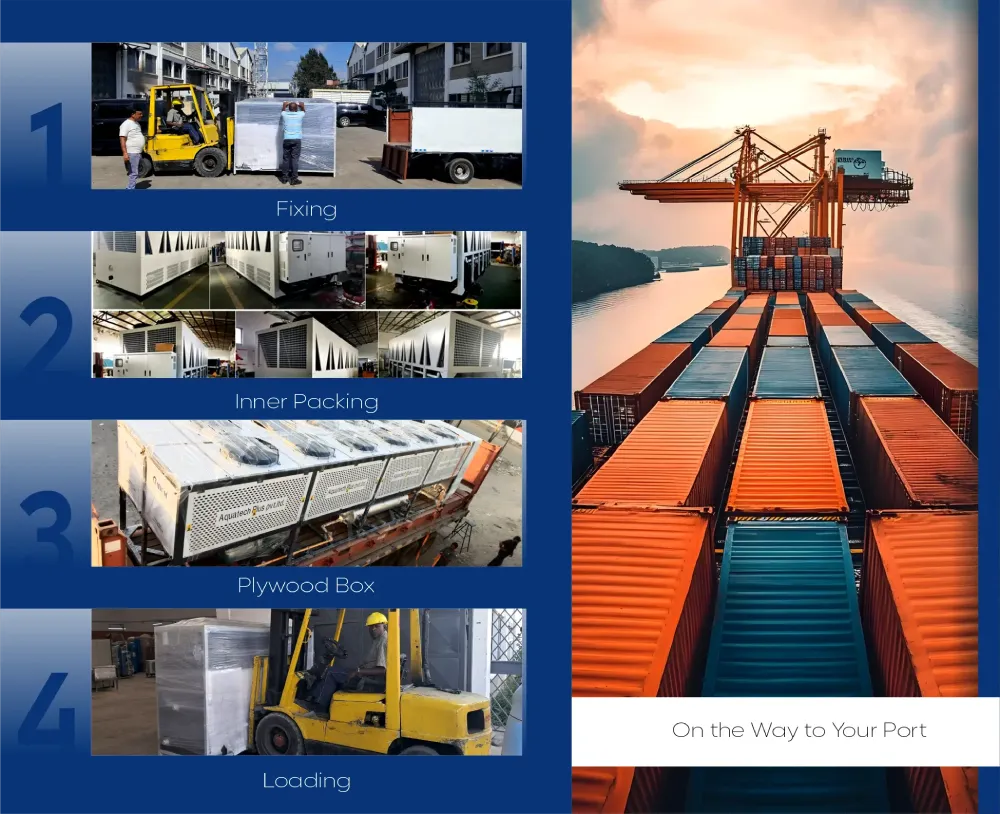
We have a uniform workflow in packaging and logistics that is export-wise, which prepares all our products except that they are safe in handling and delivery with no damages in India and other countries. Every phase is also thought out to cushion equipment against vibration, impact, and moisture risks in addition to long-distance transportation risks. The same is done to water chillers, air chillers and all other products that we produce and supply.
The process starts with mechanical repair of the unit of the product. The industrial quality fastening is used in all internal assemblies, critical parts, piping, and electrical parts. Moving components are fixed, and vibration-sensitive sites are fixed to avoid the mechanical stress during the transportation.
Objective: Avoid internal movement, vibration breakage, and alignments during transportation.
Once the repair is done the product is inner-packed with moisture-proof and shock absorbing materials. Foam padding, stretch film and cushioning materials are used as protective layers to cover all the exposed areas and all those components which are sensitive.
Objective: Dust, humidity, surface abrasion, and small mechanical shocks.
The product is packed in a specially designed heavy-duty plyboard box which is produced depending on its size and weight. The casing of the plywood is strengthened to resist the weights of the stacking, forklift operation and the transportation strain over long distances. When exporting goods, the packing is done to comply with the shipping and container loading requirements by the international community.
Objective: Optimal security on the outside and the requirements of the domestic and export logistics.
The product is loaded to the trucks with the use of cranes or forklifts, in accordance with good lifting and load-sharing practices. The delivery is then by road under conditions of control. In the case of domestic clients, the truck will go straight to the facility of the customer.
Objective: Loading and stable transportation on the road.
Whereas in international deliveries, the shipment is taken out of our plant to the Indian port. Pre-port entry All the export documentation, labeling and compliance checks are done before port entry.
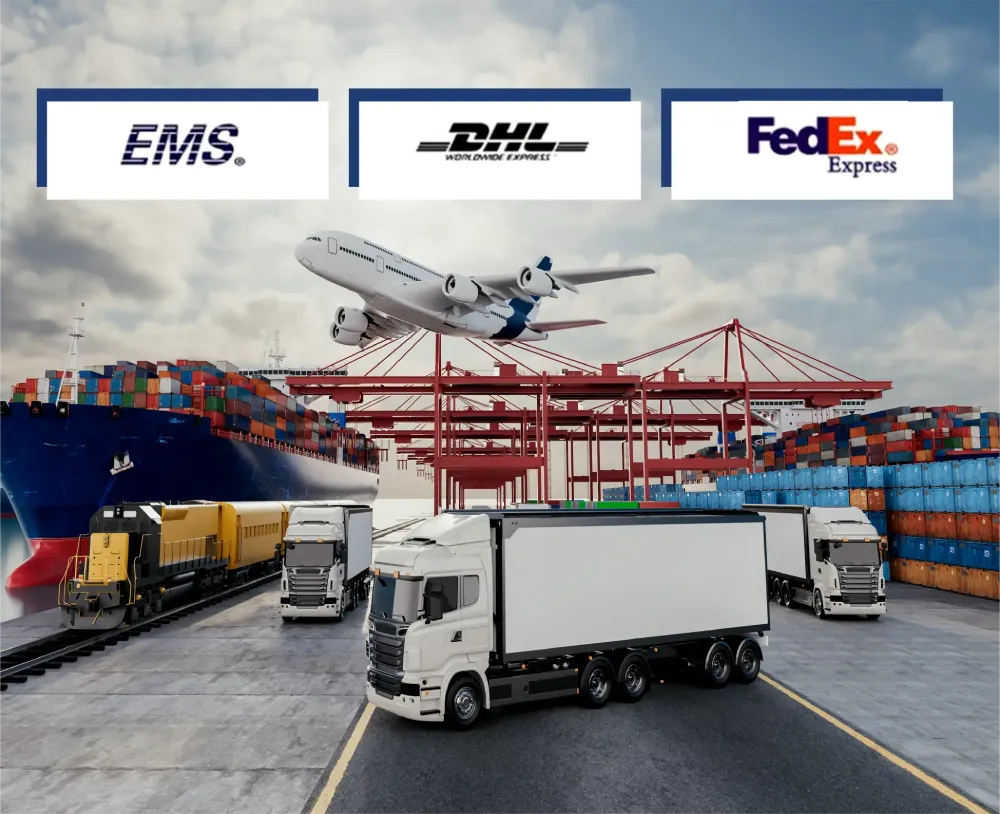
Our logistics partners are reputable and trusted individuals like EMS, DHL Express, and FedEx Express who help us to have an easy time moving the ports and handling the exports.
Goal: The port handling and export preparation are smooth.
After clearance in the port, the product is delivered through sea freight into the destination port of the client. The packaging is to maintain a long transit period, container handling and a fluctuating weather pattern.
The international deliveries are also arranged with the help of the existing world logistics systems, the EMS, DHL Express and FedEx Express, which guarantee the safe and timely delivery.
Purpose: Achieve international delivery with low levels of transits.
A clear packaging and transportation procedure would assure that all products will be delivered to the clients in working conditions, lessen installation and commission problems, minimize the risk of transit damage, and facilitate hassle-free domestic and foreign delivery.
This is our standard operating procedure and is used in the process of packaging and transportation of all our products. Although the central process is the same, a different method can be used to pack the products, depending on the product size, weight and the destination to which the product is to be shipped.
This packaging and transportation workflow represents our standard operating process and is uniformly followed across our entire product range. The steps outlined above are not product-specific but define our company-wide logistics and export handling standards.
To maintain consistency, safety, and compliance, this process is intentionally displayed across all relevant product pages under the Packaging & Transportation section. While the framework remains the same, actual packing materials, box dimensions, and handling methods may vary depending on product size, weight, and shipment destination.
From an operational standpoint, this approach ensures:
From an SEO and documentation perspective, this section is used to clearly communicate our established logistics protocol, not to repeat marketing content. Each product page focuses on its unique specifications and applications, while this section defines our common logistics standards.

Tight container has compact design where access to pumps, membranes, and filters are restricted, which require disassembly or cranes, resulting in downtime. Routine test are manageable but significant repair can take longer time without any proper planning.
When too much water enters the system, the filter cannot handle it which leads to runoff of rainwater into system and waste water is unable to pre-treated properly before reaching to filter. This problem is frequently occurred in variable flow sites like construction camps.
Mineral accumulation in the system may be as a result of changing water quality. This accumulation puts pressure and performance diminishes with time. The system can require a lot of cleaning or replacement of parts without the incorporation of antiscalants or adequate monitoring.
Pumps and blowers wear out more quickly in the mobile units due to vibrations, misalignment or overloads. Problems can be detected at an early stage through regular sensor checks.
Unexpected surges in flow bring with them an additional turbidity, which soils succeeding elements or causes downturns. These inconsistencies are equalized with the assistance of equalization tanks.
Turbidity changes overload clarifiers, causing sludge accumulation that disrupts pre-treatment. Recycle loops in sludge systems help reprocess it effectively.
We carry a specified warranty and effective after sales services to all goods provided by us. Our warranty and service system will be aimed at long-term performance, reliability in terms of work, and peace of mind of our clients, both domestic and international.
Every product has a standard warranty of manufacturing defects dating back to the dispatch date or the date of installation, as existing. The warranty includes the defects to the quality of material and workmanship in the normal operation condition.
There are various warranty terms based on the product category, model, application and environment of use. Specifics on warranty period and coverage are provided in detail during the confirmation of orders or issue of invoice.
Warranty is not applicable on damages caused by:
Our technical support provides our clients with instructions on how to install, answer technical questions as well as basic troubleshooting. Depending on where the project is located, support is accomplished by providing documentation, remote assistance or by organizing services with service partners.
We assist both domestic and foreign clients with well-organized contact and export documentation. In the case of international customers, technical support and service management are offered remotely to have a comfortable functioning and prompt problem resolution.
There is a process in which service requests are processed. When we get a support request, we examine the problem and determine the warranty eligibility and suggest a remedy. The response timelines can be different depending on the product, location and availability of the components.
The above warranty and support terms are the standard policy which we use in our whole product line. Particular product-level warranty information might vary and are provided independently when taking orders.
This Warranty & Support section represents our standard company-wide policy and is consistently applied across our complete product range. The content is intentionally displayed on multiple product pages to communicate uniform warranty coverage, service terms, and support procedures.
While the core policy remains the same, actual warranty duration, coverage scope, and service conditions may vary by product model, application, and operating environment. Product-specific warranty details are shared separately at the time of order confirmation or documentation.