- Home
- About Us
- Chillers
- Industrial RO System
- Projects
- Exhibition
- Certificates
- Infrastructure
- Contact Us
Industrial RO system is a crucial for industries, which need continuous supply of high quality water in the manufacturing and processing process. Low quality water may cause scaling, corrosion, damage of equipment and expensive downtimes. We manufactures high-performance Industrial RO Plants used in the purification of dissolved salts, minerals and impurities in order to provide reliable purified water to be used in industries. With a long-standing reputation of being a reliable Industrial RO Plant Manufacturer in India, Our systems are designed using durable components, superior filtration systems and low-energy consuming pumps to have long-term performance and operational effectiveness in various industrial operation such as manufacturing, pharmaceutical, food processing, and utility industries. It doesn’t matter if you need water for boilers, cooling towers, or production processes, our Industrial water treatment systems are built for stability, scalability, and cost efficiency.
Contact Aquatech Plus today and have a specialized Industrial RO solution that is custom-fit to meet your water needs in the plant.
In many industries whether it's a manufacturing plant, a processing plant, or a utility operation, inconsistent water quality has a significant role in scaling, corrosion, frequent breakdowns, and process inefficiencies.
An industrial RO System is manufactured in order to provide controlled, high-quality water output suitable for industrial manufacturing processes. In comparison to domestic ro machine, industrial ro machine are precisely engineered for high flow rates, seamless operation, and required raw water treatment.
At the core of industrial RO setup is an advanced industrial ro water treatment system which decreases the concentration of inorganic salts i.e., calcium, magnesium, sodium and organic matter dissolved in water, expressed in mg/L or ppm. It helps industries to get the continuous water parameter for daily operation.
In this segment, Aquatech Plus stand as a trusted Industrial RO Plant Manufacturers in India, delivering high-performance reverse osmosis systems engineered for demanding manufacturing environment. Our Industrial RO Plant is manufactured to provide purified water output continuously, improved operational performance, and long term cost efficiency in various sectors like manufacturing, pharmaceuticals, food processing, and utility sector.
Aquatech Plus, being an experienced RO Plant Manufacturers in India focuses on manufacturing of capacity based plants covering 1000 LPH and beyond. Our plants are built with high-grade components, durable materials, and precision engineering to ensure consistent performance in real industrial condition.
Key Highlights:
We make sure your system deliver consistent operation over year not just installation.
An Industrial Reverse Osmosis System is a large scale water purification plant that uses high-pressure filtration through RO membranes to eliminate contaminants, impurities, and TDS from raw water. In reality, it function as a complete industrial ro water purifier system which is built for manufacturing units like factories, processing plant, and large commercial operations.
Industrial RO systems are widely used for:
The principle of an industrial RO water system is very simple; this forces water to pass through semi-permeable RO membrane with the help of a high pressure pump. The membrane element included in the Industrial RO Water System Filters the undesirable elements (such as salts, heavy metals, dissolved minerals, bacteria, etc.) allowing only pure water molecules to move through the element.
The process results in two outputs:
The overall performance relies on raw water quality, pre-treatment, membrane grade and operating pressure.
An industrial RO plant operates strategically in sequence:
Water comes into the plant from a borewell, municipal supply, surface water, or a storage tank.
Pre-treatment is critical for any RO plant. It safeguards the RO membranes and increases the system’s lifespan.
Most industrial RO projects include:
This pre-treatment process is a building block of industrial ro filter system which make sure consistent membrane performance.
The pump of high pressure provides the needed force to overcome the osmotic pressure forcing the water through the membrane. Selection of pump is dependent on the TDS levels, required flow and system recovery.
RO membrane is considered as the first stage of purification. In various industrial systems, Thin-Film Composite (TFC) membranes are used because of high purity and long-term dependability when pre-treatment is properly conducted.
Modern unit incorporates advance automated components for uninterrupted flow:
When this pre-treatment and monitoring are added to RO membrane, the entire system turns out to be an industrial ro water filter system that is optimized to be used continuously in the industry.
Being a professional Industrial RO System Manufacturers in India, Aquatech Plus built systems which don’t just do basic filtration. Our Industrial RO solution comes with:
Every system is manufactured after conducting raw water TDS, hardness levels, daily consumption requirements, and future expansion plans. This engineering-first approach make sure long term operational stability.
Aquatech Plus is well-known among reliable RO Plant Suppliers in India, delivering complete project support form tailored system manufacturing to commissioning and after sale service.
Our supply scope includes:
The industrial buyers normally use capacity as a search criteria since it directly affects the production requirements and rate of production per day. The most plausible mid-size industrial need is the range of the Aquatech Plus capacity:
Available Capacities Are:
Here is a real-life perspective that would aid your choice of the correct capacity.
Daily treated water output is based on runtime. A simple reference is:
Note:
Real output is based on the number of hours operated on a daily basis. When the plant will operate only 8-12 hours a day, the amount of water, which will be produced, will also decrease accordingly. Selection of capacity depends on the timing of shifts, storage capacity, process requirement and future expansion strategies.
The selection of industrial ro systems for manufacturing plants is influenced by following points:
A packaging unit can only require constant water to wash and rinse. The pharma or food unit must have tighter parameters. A unit of textile usually requires a powerful pre-treatment and regular rejection due to the fluctuations in the raw water and the risk of scaling is greater. A manufacturing facility with boilers should pay attention to the hardness and low TDS in order to prevent the scaling on the tubes and heating surfaces.
Automation contributes significantly to the safety of plants, manpower, and the consistency of operation. Industrial RO systems are normally provided in:
It is Ideal in long-term operations, where the operation of the industry is controlled by rules, and when the plant requires predictable performance and has a minimal number of operators.
Common automatic capabilities are:
Suitable for:
It is a balanced option for those who want partial automation with some of the human intervention.
Typically includes:
Suitable for:
Manual systems are run by operators and tend to be selected because of low capacity or cost-sensitive operations.
Typically includes:
Suitable for:
Membranes are not the only components of a professional industrial RO solution. It is an entire designed system. Key elements include:
That is why an adequate plant can best be termed as an industrial ro water filter system not just a purifier, since it has a complete filtration and treatment cycle.
The choice of material is based on the usage, the nature of water and hygiene necessity.
Preferred for:
Advantages:
Preferred for:
Advantages:
The application of industrial RO systems can be seen in a very diverse set of industries:
This is precisely the reason why industrial purchasers tend to consider RO plants as a necessity but not a luxury.
The level of TDS of the raw water has a direct effect on the design of the plant, the choice of membrane, pump pressure and recovery of the system.
In industries that use difficult raw water, pre-treatment and dosing system cannot be left out without any proper planning. It is what determines whether your RO plant becomes a smooth operation years or it continues to fail after every several months.
The majority of B2B customers would like to get a simple response concerning Industrial ro system price. Actually, the prices of industrial RO differ since each plant is intended to deal with raw water and the necessary quality of output.
A real buyer must not be restricted to fixed numbers, but to determine what motivates the cost to establish the RO Water Plant.
Price comparison is quite fundamental as many industries buy RO plants according to LPH capacity. This turns out to be expensive in the long run.
Two plants of the same capacity can vary in a great deal since:
In the long run, the outcomes of poor pre-treatment are:
A high-quality industrial RO system is one that is constructed to be very stable.
The industrial customers desire three aspects:
Aquatech Plus can position well by concentrating on:
Most industries do not necessarily select a good RO vendor because of the lowest priced plant. It is the one who manufactures a plant that is running consistently with few unexpected operational surprises.
This is the place to start with, should you be planning an industrial RO project:
These having been clear, you may make final:
To the industrial buyers who need a stable and scalable solution throughout the process – Aquatech Plus is capable of assisting in the entire process, which includes selection, commissioning, and continued support of the operation.
| Category | Parameter | Specification / Range | Unit | Description / Remarks |
|---|---|---|---|---|
| General | System Type | Industrial Reverse Osmosis Plant | — | High-capacity water purification system |
| General | Installation Type | Skid Mounted / Modular | — | Easy installation and maintenance |
| General | System Capacity | 250 – 100,000+ | LPH | Customizable based on industrial requirement |
| General | Recovery Rate | 40 – 75 | % | Depends on feed water quality |
| General | Salt Rejection | 95 – 99.5 | % | RO membrane efficiency |
| Feed Water | Feed Water Source | Borewell / Municipal / Surface | — | Raw water supply source |
| Feed Water | Feed Water TDS | Up to 2000 | ppm | Higher with special membranes |
| Feed Water | Temperature | 5 – 45 | °C | Recommended operating range |
| Feed Water | pH Range | 3 – 11 | — | Compatible with membrane limits |
| Feed Water | Turbidity | < 5 | NTU | Ensures membrane protection |
| Pretreatment | Sand Filter Media | Quartz / Silica | — | Removes suspended solids |
| Pretreatment | Activated Carbon Media | Coconut Shell Carbon | — | Removes chlorine and odor |
| Pretreatment | Micron Cartridge Filter | 5 / 10 | Micron | Final filtration before membrane |
| Pretreatment | Antiscalant Dosing | Adjustable | — | Prevents scaling on membranes |
| Pretreatment | Chemical Dosing Tank | HDPE | — | Chemical storage for dosing |
| Membrane Section | Membrane Type | Thin Film Composite (TFC) | — | High efficiency filtration |
| Membrane Section | Membrane Size | 4 / 8 | Inch | Spiral wound membranes |
| Membrane Section | Membrane Material | Polyamide | — | Durable and chemical resistant |
| Membrane Section | Membrane Housing | FRP / SS304 / SS316 | — | Pressure vessel for membranes |
| Membrane Section | Operating Pressure | 10 – 25 | Bar | Required for RO filtration |
| Pumps | Raw Water Pump Type | Centrifugal Pump | — | Feeds water to pretreatment |
| Pumps | High Pressure Pump | Multistage Pump | — | Creates pressure for RO membranes |
| Pumps | Pump Material | SS304 / SS316 | — | Corrosion resistant |
| Pumps | Pump Power | 1 – 15 | HP | Depends on system size |
| Piping | Pipe Material | UPVC / SS / CPVC | — | Corrosion resistant piping |
| Piping | Pipe Diameter | ½ – 4 | Inch | Depends on flow capacity |
| Piping | Valves | Ball / Butterfly / NRV | — | Flow control and safety |
| Piping | Pressure Rating | PN10 / PN16 | — | Industrial pressure tolerance |
| Instrumentation | Pressure Gauge | Analog / Digital | — | Measures feed pressure |
| Instrumentation | Flow Meter | Rotameter / Digital | — | Measures product & reject flow |
| Instrumentation | TDS Meter | Online Digital | ppm | Monitors water purity |
| Instrumentation | Conductivity Meter | Online | µS/cm | Checks dissolved solids |
| Instrumentation | Level Sensor | Float / Ultrasonic | — | Tank level monitoring |
| Electrical | Power Supply | 220 / 415 | Volt | Single or three phase |
| Electrical | Frequency | 50 | Hz | Standard industrial frequency |
| Electrical | Control Panel | PLC / Microcontroller | — | Automated system control |
| Electrical | Protection | MCB / Overload Relay | — | Electrical safety |
| Output | Product Water TDS | < 50 | ppm | Depends on feed water |
| Output | Reject Water Flow | 25 – 60 | % | Waste stream from RO |
| Output | Energy Consumption | 0.8 – 2 | kWh/m³ | Depends on pump size |
| Safety | Low Pressure Switch | Installed | — | Prevents dry running |
| Safety | High Pressure Switch | Installed | — | Protects membranes |
| Safety | Auto Flush System | Available | — | Reduces membrane fouling |
| Maintenance | Membrane Life | 2 – 3 | Years | With proper maintenance |
| Maintenance | Cartridge Filter Change | 1 – 3 | Months | Depends on water quality |
| Optional | UV Sterilizer | Optional | — | Kills bacteria |
| Optional | Ozonation System | Optional | — | Additional water disinfection |
| Optional | CIP System | Optional | — | Membrane chemical cleaning |
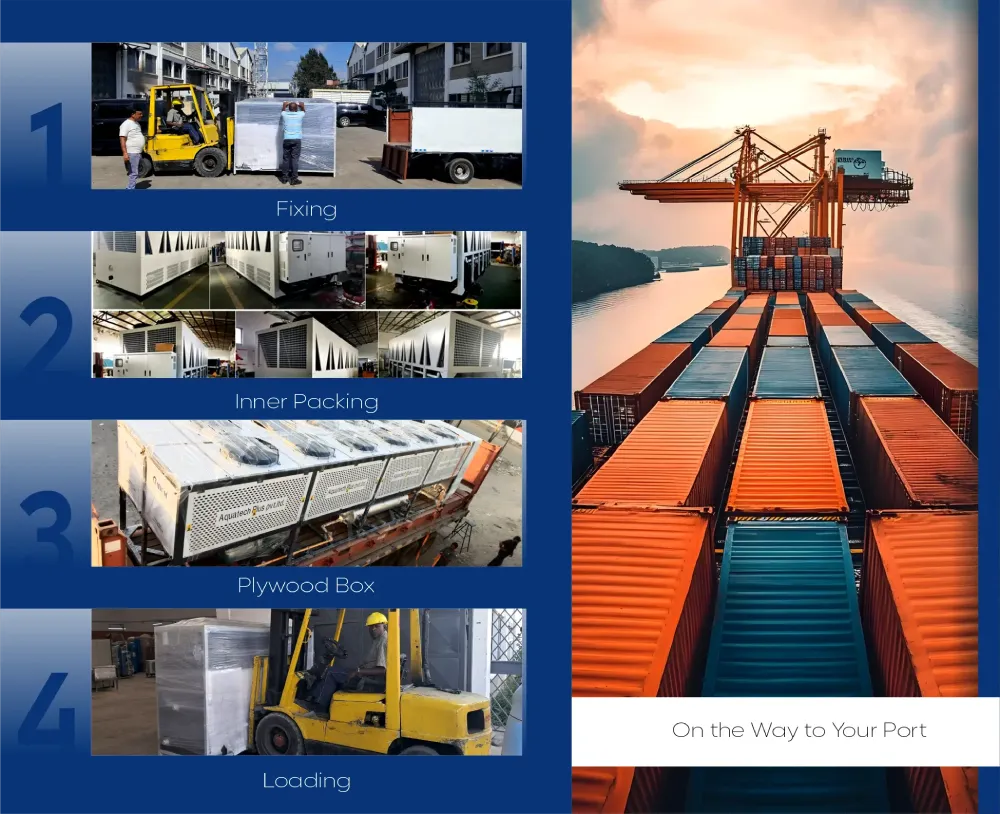
We have a uniform workflow in packaging and logistics that is export-wise, which prepares all our products except that they are safe in handling and delivery with no damages in India and other countries. Every phase is also thought out to cushion equipment against vibration, impact, and moisture risks in addition to long-distance transportation risks. The same is done to water chillers, air chillers and all other products that we produce and supply.
The process starts with mechanical repair of the unit of the product. The industrial quality fastening is used in all internal assemblies, critical parts, piping, and electrical parts. Moving components are fixed, and vibration-sensitive sites are fixed to avoid the mechanical stress during the transportation.
Objective: Avoid internal movement, vibration breakage, and alignments during transportation.
Once the repair is done the product is inner-packed with moisture-proof and shock absorbing materials. Foam padding, stretch film and cushioning materials are used as protective layers to cover all the exposed areas and all those components which are sensitive.
Objective: Dust, humidity, surface abrasion, and small mechanical shocks.
The product is packed in a specially designed heavy-duty plyboard box which is produced depending on its size and weight. The casing of the plywood is strengthened to resist the weights of the stacking, forklift operation and the transportation strain over long distances. When exporting goods, the packing is done to comply with the shipping and container loading requirements by the international community.
Objective: Optimal security on the outside and the requirements of the domestic and export logistics.
The product is loaded to the trucks with the use of cranes or forklifts, in accordance with good lifting and load-sharing practices. The delivery is then by road under conditions of control. In the case of domestic clients, the truck will go straight to the facility of the customer.
Objective: Loading and stable transportation on the road.
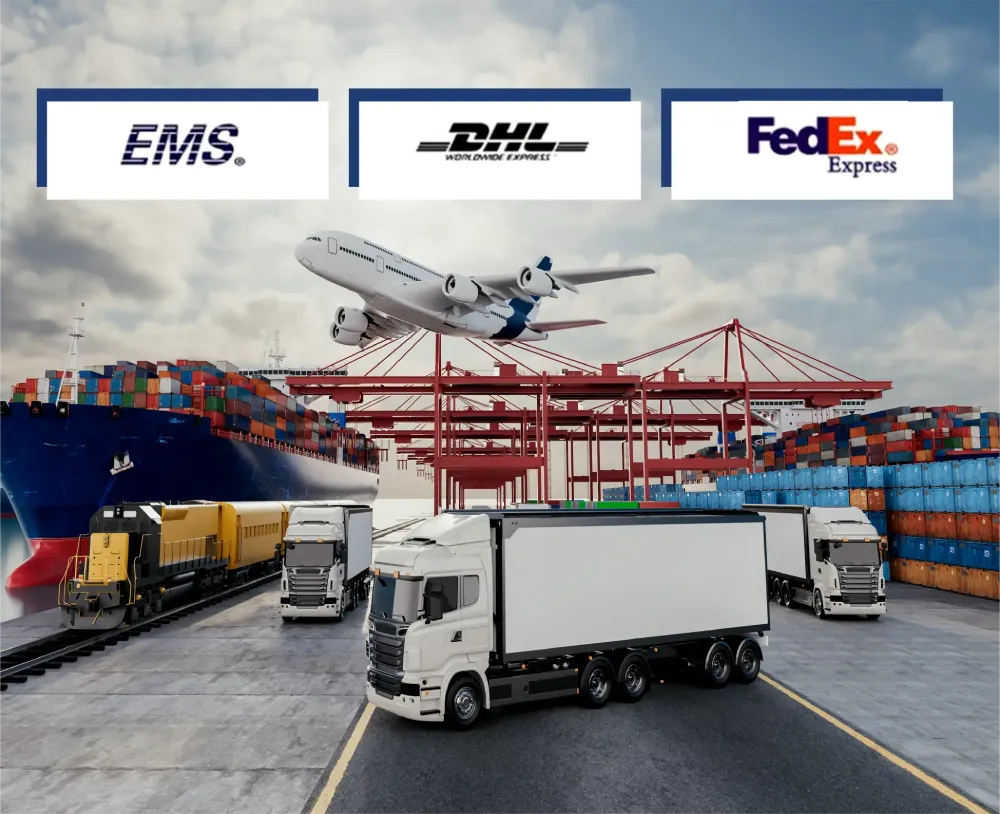
Whereas in international deliveries, the shipment is taken out of our plant to the Indian port. Pre-port entry All the export documentation, labeling and compliance checks are done before port entry.
Our logistics partners are reputable and trusted individuals like EMS, DHL Express, and FedEx Express who help us to have an easy time moving the ports and handling the exports.
Goal: The port handling and export preparation are smooth.
After clearance in the port, the product is delivered through sea freight into the destination port of the client. The packaging is to maintain a long transit period, container handling and a fluctuating weather pattern.
The international deliveries are also arranged with the help of the existing world logistics systems, the EMS, DHL Express and FedEx Express, which guarantee the safe and timely delivery.
Purpose: Achieve international delivery with low levels of transits.
A clear packaging and transportation procedure would assure that all products will be delivered to the clients in working conditions, lessen installation and commission problems, minimize the risk of transit damage, and facilitate hassle-free domestic and foreign delivery.
This is our standard operating procedure and is used in the process of packaging and transportation of all our products. Although the central process is the same, a different method can be used to pack the products, depending on the product size, weight and the destination to which the product is to be shipped.
This packaging and transportation workflow represents our standard operating process and is uniformly followed across our entire product range. The steps outlined above are not product-specific but define our company-wide logistics and export handling standards.
To maintain consistency, safety, and compliance, this process is intentionally displayed across all relevant product pages under the Packaging & Transportation section. While the framework remains the same, actual packing materials, box dimensions, and handling methods may vary depending on product size, weight, and shipment destination.
From an operational standpoint, this approach ensures:
From an SEO and documentation perspective, this section is used to clearly communicate our established logistics protocol, not to repeat marketing content. Each product page focuses on its unique specifications and applications, while this section defines our common logistics standards.

When we install new filters, sometimes air gets trapped which causes a noisy faucet or drain. It is normal and fades in one week with no need to fix.
When your RO faucet is leaking loose fittings or O-rings can be the reason behind it. Check connection, tighten if needed or replace the seals.
When filter membrane is depleted or water remains on its surface makes purified water taste bad and foul odour. Make timely maintenance every 1 to 2 years for fresh taste and water.
Your RO system keeps running if the shut-off valve or check valve is not functioning properly, or if the tank pressure is too low (below 35–40 PSI). Fix it by adjusting the pressure or replacing the valves.
Water flow slows down when pre-filters are dirty or there is no appropriate tank pressure, something like less than 6 – 8 PSI, or fouled membranes. By cleaning it or replacing this part results in high water flow.
When membranes get outdated or seals get damaged, they let impurities pass through from them. Solve this by replacing the RO membrane timely.
We carry a specified warranty and effective after sales services to all goods provided by us. Our warranty and service system will be aimed at long-term performance, reliability in terms of work, and peace of mind of our clients, both domestic and international.
Every product has a standard warranty of manufacturing defects dating back to the dispatch date or the date of installation, as existing. The warranty includes the defects to the quality of material and workmanship in the normal operation condition.
There are various warranty terms based on the product category, model, application and environment of use. Specifics on warranty period and coverage are provided in detail during the confirmation of orders or issue of invoice.
Warranty is not applicable on damages caused by:
Our technical support provides our clients with instructions on how to install, answer technical questions as well as basic troubleshooting. Depending on where the project is located, support is accomplished by providing documentation, remote assistance or by organizing services with service partners.
We assist both domestic and foreign clients with well-organized contact and export documentation. In the case of international customers, technical support and service management are offered remotely to have a comfortable functioning and prompt problem resolution.
There is a process in which service requests are processed. When we get a support request, we examine the problem and determine the warranty eligibility and suggest a remedy. The response timelines can be different depending on the product, location and availability of the components.
The above warranty and support terms are the standard policy which we use in our whole product line. Particular product-level warranty information might vary and are provided independently when taking orders.
This Warranty & Support section represents our standard company-wide policy and is consistently applied across our complete product range. The content is intentionally displayed on multiple product pages to communicate uniform warranty coverage, service terms, and support procedures.
While the core policy remains the same, actual warranty duration, coverage scope, and service conditions may vary by product model, application, and operating environment. Product-specific warranty details are shared separately at the time of order confirmation or documentation.