
- Home
- About Us
- Chillers
- Industrial RO System
- Projects
- Exhibition
- Certificates
- Infrastructure
- Contact Us
Low Temperature Chiller is a sophisticated cooling system that is developed to create and sustain low-zero or even lower temperatures of appearance to facilitate severe industrial and scientific activities. It is commonly used in Pharmaceuticals, chemical processing, labs, food freezing lines, medical research and special manufacturing applications, where maintaining low temperatures is necessary. These are engineered to withstand the challenging environment and have wide temperature operating limits with stable and consistent cooling performance. Other important factors to consider during the choice of these systems are the range of temperatures that can be reached, cooling ability of the system, efficiency of the compressor, arrangement of the compressor and its ability to run with constant power.
Constructed using high performance refrigeration equipment, heavy insulation and precise control, these chillers are developed to provide durability of service and operational security. During the selection of a low temperature chiller, it is recommended to select the most suitable chiller to guard sensitive processes, enhance product integrity and sustain continuous operations under temperature sensitive conditions.
Low Temperature Chillers are intended to be used in industries where the temperature of the chilled water should be decreased to lower than normal temperatures so that the process and the quality of the product remain the same. Aquatech Plus is a specialised Low Temperature Chiller Manufacturers in India and also designs systems to operate continuously in sub-zero mode, whereby reliable cooling is guaranteed even in the harsh industrial operational conditions.
These systems work due to the glycol cooling circuits, which enable the safe transfer of heat to temperatures that are lower than the freezing point of water. The design eliminates the chance of ice formation, safeguards internal parts and maintains constant outlet temperatures without a thermal shock. Use of low-temperature chillers is common where accuracy of the process, equipment protection and long-term reliability are of importance.
Chillers: Low-temperature chillers are designed to achieve accurate cooling at negative and near-freezing temperatures. Fridge architecture, evaporation choice and control logic are set up to allow deep cooling while being energy efficient and mechanically sound.
The system provides reliable cooling performance at long run of operations and intermittent thermal loads and is therefore applicable to industries that have the need to maintain a low temperature environment throughout.
Low Temperature Chillers are applied in industries where the process efficiency and product stability directly depend on the temperature change.
Examples include:
Constant sub-zero working conditions guarantee stable quality production, lowered downtimes and regulated process conditions.
Aquatech Plus is one of the trustworthy Low Temperature Chiller Suppliers in India and offers systems programmed based on the real operating temperature needs, loads, and location conditions, as opposed to the common configurations.
Every unit is individually tested in factories to ensure its performance, safety and operational stability and is ready to serve in the continuous industrial service.
Supplier Benefits Include:
The design of low-temperature chillers is based on thermal precision, mechanical reliability and high reliability of long-term service.
Core Engineering Highlights
The low-temperature chillers also have distinct lines of operation, so the system can be reliable:
Aquatech Plus operates as a reliable Low Temperature Chiller Dealers in India by having an organised distribution channel that facilitates the selection of systems, planning of their installation and subsequent long-term operation.
Dealer Support Includes:
Aquatech Plus is also identified as a reliable Low Temperature Chiller Exporters in India that provide export ready systems for different climatic and industrial environments.
Export Capabilities Include
Choosing the appropriate low-temperature chiller is a necessary factor in ensuring efficiency in the process, the integrity of products, and equipment safety. Aquatech Plus offers low-temperature chiller systems created to operate at stable sub-zero temperatures, energy and long-term industrial durability.
Our technical staff analyses your process parameters, temperature profile needed, loads and location to suggest a solution that matches your objectives in production. Contact us to talk about your application and find a low-temperature cooling system designed to be reliable in industrial operation.
| Parameter | Specification |
|---|---|
|
Chiller Type |
Low Temperature Chiller |
|
Cooling Method |
Air Cooled / Water Cooled |
|
Cooling Capacity Range |
5 kW – 300 kW |
|
Operating Temperature Range |
-40°C to +10°C |
|
Temperature Stability |
±0.3°C |
|
Cooling Medium |
Water + Glycol |
|
Glycol Concentration |
20% – 50% |
|
Refrigerant Type |
R404A / R507 / R134a |
|
Compressor Type |
Scroll / Screw (Low Temperature Rated) |
|
Compressor Operation |
Continuous Duty |
|
Capacity Control |
Fixed / Step / Inverter-Based |
|
Power Supply |
3 Phase, 380V / 415V, 50Hz |
|
Maximum Input Power |
Up to 90 kW (Model Dependent) |
|
Condenser Type |
Air: Finned Copper Tube / Water: Shell & Tube |
|
Evaporator Type |
Shell & Tube / Plate Heat Exchanger |
|
Chilled Fluid Flow Rate |
1 m³/h – 60 m³/h |
|
Water Pressure Drop |
35 – 65 kPa |
|
Control System |
PLC / Microprocessor Controller |
|
Display Interface |
Digital / Touch Screen |
|
Communication |
RS485 / Modbus (Optional) |
|
Noise Level |
≤ 68 dB(A) |
|
Safety Protections |
HP/LP, Overload, Phase Loss, Flow Switch, Anti-Freezing |
|
Ambient Operating Temperature |
Up to 45°C |
|
Installation Type |
Indoor / Outdoor |
|
Construction |
Powder-Coated Industrial Steel Body |
|
Mounting |
Anti-Vibration Pads |
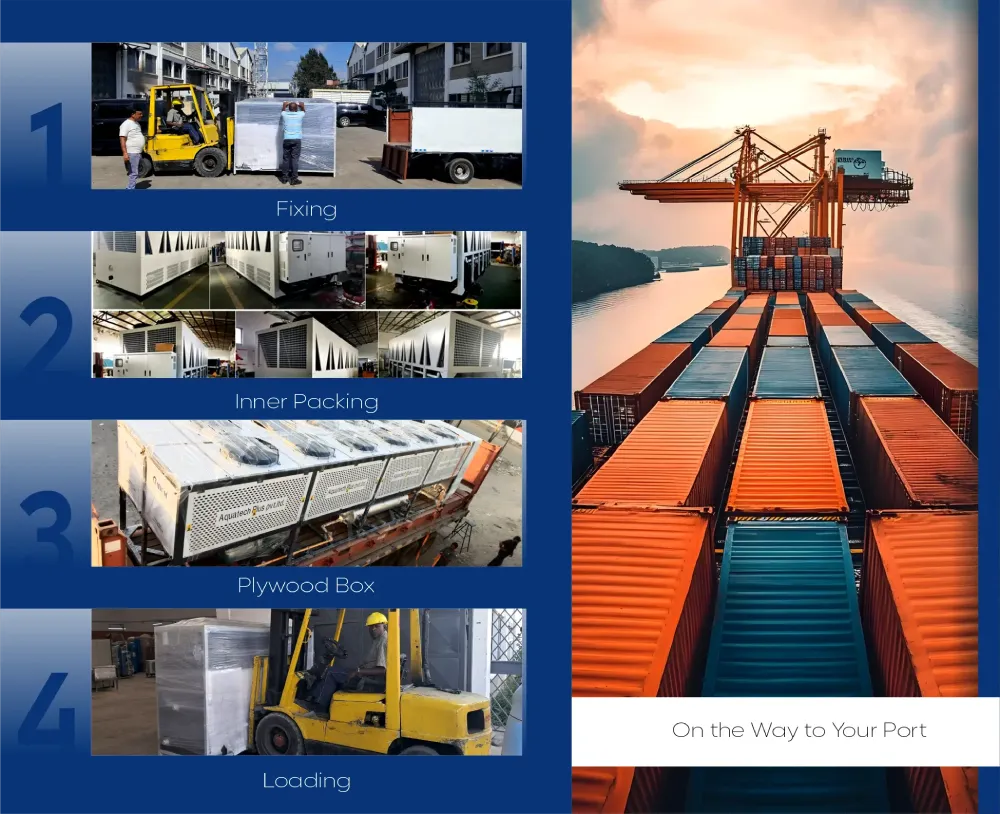
We have a uniform workflow in packaging and logistics that is export-wise, which prepares all our products except that they are safe in handling and delivery with no damages in India and other countries. Every phase is also thought out to cushion equipment against vibration, impact, and moisture risks in addition to long-distance transportation risks. The same is done to water chillers, air chillers and all other products that we produce and supply.
The process starts with mechanical repair of the unit of the product. The industrial quality fastening is used in all internal assemblies, critical parts, piping, and electrical parts. Moving components are fixed, and vibration-sensitive sites are fixed to avoid the mechanical stress during the transportation.
Objective: Avoid internal movement, vibration breakage, and alignments during transportation.
Once the repair is done the product is inner-packed with moisture-proof and shock absorbing materials. Foam padding, stretch film and cushioning materials are used as protective layers to cover all the exposed areas and all those components which are sensitive.
Objective: Dust, humidity, surface abrasion, and small mechanical shocks.
The product is packed in a specially designed heavy-duty plyboard box which is produced depending on its size and weight. The casing of the plywood is strengthened to resist the weights of the stacking, forklift operation and the transportation strain over long distances. When exporting goods, the packing is done to comply with the shipping and container loading requirements by the international community.
Objective: Optimal security on the outside and the requirements of the domestic and export logistics.
The product is loaded to the trucks with the use of cranes or forklifts, in accordance with good lifting and load-sharing practices. The delivery is then by road under conditions of control. In the case of domestic clients, the truck will go straight to the facility of the customer.
Objective: Loading and stable transportation on the road.
Whereas in international deliveries, the shipment is taken out of our plant to the Indian port. Pre-port entry All the export documentation, labeling and compliance checks are done before port entry.
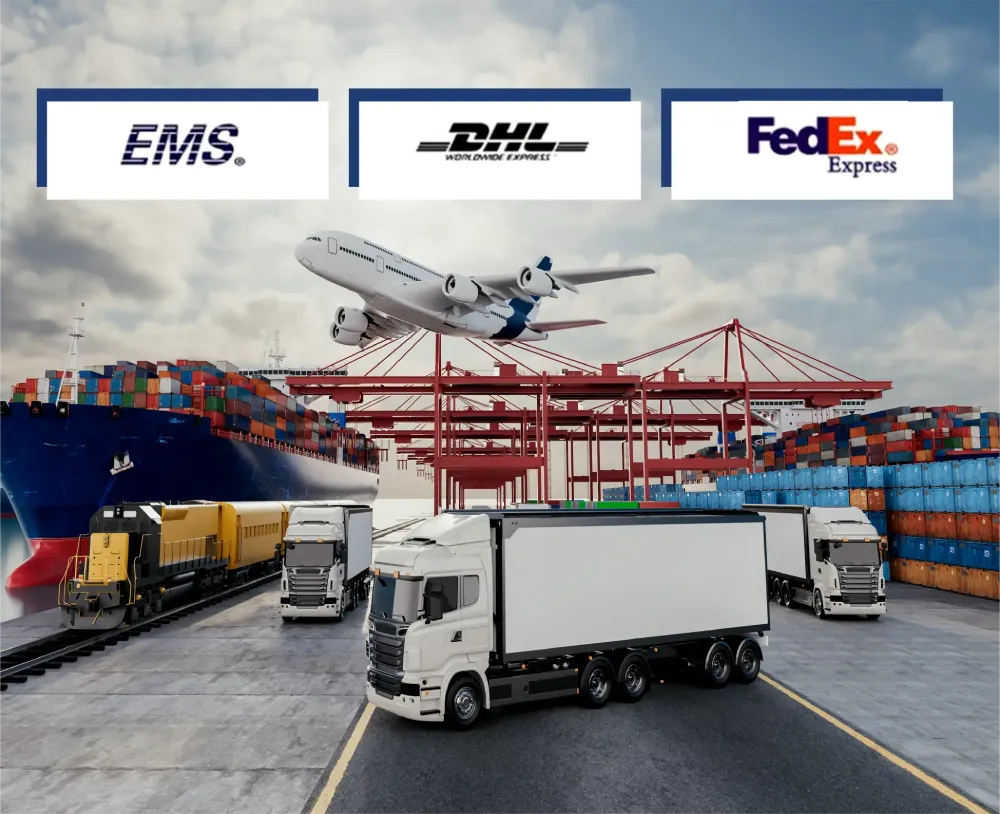
Our logistics partners are reputable and trusted individuals like EMS, DHL Express, and FedEx Express who help us to have an easy time moving the ports and handling the exports.
Goal: The port handling and export preparation are smooth.
After clearance in the port, the product is delivered through sea freight into the destination port of the client. The packaging is to maintain a long transit period, container handling and a fluctuating weather pattern.
The international deliveries are also arranged with the help of the existing world logistics systems, the EMS, DHL Express and FedEx Express, which guarantee the safe and timely delivery.
Purpose: Achieve international delivery with low levels of transits.
A clear packaging and transportation procedure would assure that all products will be delivered to the clients in working conditions, lessen installation and commission problems, minimize the risk of transit damage, and facilitate hassle-free domestic and foreign delivery.
This is our standard operating procedure and is used in the process of packaging and transportation of all our products. Although the central process is the same, a different method can be used to pack the products, depending on the product size, weight and the destination to which the product is to be shipped.
This packaging and transportation workflow represents our standard operating process and is uniformly followed across our entire product range. The steps outlined above are not product-specific but define our company-wide logistics and export handling standards.
To maintain consistency, safety, and compliance, this process is intentionally displayed across all relevant product pages under the Packaging & Transportation section. While the framework remains the same, actual packing materials, box dimensions, and handling methods may vary depending on product size, weight, and shipment destination.
From an operational standpoint, this approach ensures:
From an SEO and documentation perspective, this section is used to clearly communicate our established logistics protocol, not to repeat marketing content. Each product page focuses on its unique specifications and applications, while this section defines our common logistics standards.

Standard chillers are not designed to handle freezing risks, whereas low temperature chillers use special refrigerants, insulation, and controls for safe sub-zero operation.
Low temperature chillers are critical in pharmaceuticals, chemical processing, breweries, food freezing, and research facilities requiring controlled sub-zero environments.
These systems use glycol or special heat transfer fluids that remain stable at low temperatures, ensuring smooth circulation and protecting pipes from ice formation.
While sub-zero cooling requires more energy, modern low temperature chillers use efficient compressors and smart controls to reduce unnecessary power consumption.
Yes, advanced low temperature chillers adjust compressor output and flow rates quickly to maintain stable temperatures even during rapid load fluctuations.
Key safety features include low-temperature cut-offs, pressure protection, flow monitoring, and insulation safeguards to ensure safe and reliable long-term operation.
We carry a specified warranty and effective after sales services to all goods provided by us. Our warranty and service system will be aimed at long-term performance, reliability in terms of work, and peace of mind of our clients, both domestic and international.
Every product has a standard warranty of manufacturing defects dating back to the dispatch date or the date of installation, as existing. The warranty includes the defects to the quality of material and workmanship in the normal operation condition.
There are various warranty terms based on the product category, model, application and environment of use. Specifics on warranty period and coverage are provided in detail during the confirmation of orders or issue of invoice.
Warranty is not applicable on damages caused by:
Our technical support provides our clients with instructions on how to install, answer technical questions as well as basic troubleshooting. Depending on where the project is located, support is accomplished by providing documentation, remote assistance or by organizing services with service partners.
We assist both domestic and foreign clients with well-organized contact and export documentation. In the case of international customers, technical support and service management are offered remotely to have a comfortable functioning and prompt problem resolution.
There is a process in which service requests are processed. When we get a support request, we examine the problem and determine the warranty eligibility and suggest a remedy. The response timelines can be different depending on the product, location and availability of the components.
The above warranty and support terms are the standard policy which we use in our whole product line. Particular product-level warranty information might vary and are provided independently when taking orders.
This Warranty & Support section represents our standard company-wide policy and is consistently applied across our complete product range. The content is intentionally displayed on multiple product pages to communicate uniform warranty coverage, service terms, and support procedures.
While the core policy remains the same, actual warranty duration, coverage scope, and service conditions may vary by product model, application, and operating environment. Product-specific warranty details are shared separately at the time of order confirmation or documentation.