
- Home
- About Us
- Chillers
- Industrial RO System
- Projects
- Exhibition
- Certificates
- Infrastructure
- Contact Us
Commercial Blast Chiller is a fast cooling device used in commercial food processing and catering facilities to reduce the temperature of cooked or raw food stuff in a short space of time. Such systems are very important in maintaining food quality, texture and safety as they pass through extreme temperatures. Blast chillers find wide application in commercial kitchens, food processing plants, bakeries, dairy plants, hotels, and central kitchens where compressed cooling is a major requirement.
These are designed to satisfy high product loads with trays or containers receiving equal cooling. Other important aspect to be taken into account during the selection are: chilling capacity, the rate of cooling, hygiene, energy efficiency and the reliability of its operation. Blast chillers are designed to have good insulation, good circulation of air and accurate regulation of temperature to ensure normal functioning and extended service life. Selecting an appropriate commercial blast chiller facilitates waste reduction, shelf life and food safety standards in the challenging commercial processes.
Aquatech Plus is a Commercial Blast Chillers Manufacturers in India; the company manufactures engineered chilling systems that have been designed to operate in its food settings where quick temperature drops, cleanliness, and stability of processes are highly required. The commercial blast chilling is an essential part of the food handling operation, as there is a direct relationship between the controlled cooling and the food safety and consistency of the food and operational planning. The systems have been extensively used in commercial kitchens, bakeries, hospitality units, food processing plants, and cold-chain operations.
A Commercial Blast Chiller is meant to transport unchilled or processed food over the critical temperature ranges with controlled time cycles. Fast and consistent cooling will limit bacterial growth and preserve food texture, moisture, and appearance. Such systems are designed in environments where predictability of cooling behaviour is needed, balanced air flow, and reliability in operating when under daily repetitive use is needed.
Commercial Blast Chillers are made available in a variety of food handling settings:
Having an efficient blast chilling helps to decrease waste and enhance scheduling of the working process and food safety standards.
Being an organised Commercial Blast Chiller Suppliers in India, Aquatech Plus maintains the set practices of inspection and quality checks before shipment.
The consideration of the suppliers would be:
The units are usually tested on temperature accuracy, air balance, electrical safety, and reliability.
Being experienced Commercial Blast Chillers Dealers in India, Aquatech Plus offers its customers technical guidance in selection, as opposed to general sales.
The dealer support generally includes:
Proper technical instructions are useful to facilitate a seamless fit in everyday activities.
Aquatech Plus is a dependable Commercial Blast Chiller Exporters in India, which provides systems that are ready to work in international food service and food processing conditions.
The strength related to exports is as follows:
Commercial Blast Chiller Solutions are offered in Aquatech Plus for professional food facilities where temperature accuracy, compliance with controlled cooling and hygiene are very important. These systems confine refrigeration efficiency, airflow regulation and sanitary construction to facilitate quality daily use.
Connect with the technical team and negotiate on kitchen space, food types and operations expectations. Every Commercial Blast Chiller setup is aligned to safety measures, uniform operation, and long-term operational value.
| Section | Parameter | Specification / Notes |
|---|---|---|
| Product Overview | Product Type | Commercial Blast Chiller / Blast Freezer |
| Use | Rapid cooling & freezing of cooked or raw food to safe storage temperatures (+3°C / -18°C) | |
| Capacity | Tray / Load Capacity | e.g., 30–200 kg per cycle (varies by model) |
| Number of Trays | Commonly 6–20 trays (GN 1/1 or equivalent) | |
| Cooling Performance | Blast Chilling Cycle | 90°C to +3°C in ≤90 min (typical) |
| Freezing Cycle | 90°C to -18°C in ≤240–270 min (optional freezing) | |
| Cooling Method | High-velocity forced air circulation | |
| Temperature Range | Chilling | 3°C (target holding temp) |
| Freezing | Down to -18°C (optional) | |
| Refrigeration System | Refrigerant | R290, R404A, R452A, R448A/R449A or similar |
| Compressor | Hermetic / Semi-Hermetic | |
| Construction | Cabinet Material | Stainless Steel (AISI 304 interior/exterior) |
| Insulation | High-density polyurethane | |
| Electrical | Power Supply | Single or 3-phase (e.g., 220–240 V / 380–415 V, 50 Hz) |
| Power Consumption | Typically 1.3–5 kW (varies by capacity) | |
| Controls & Display | Control Panel | Digital / Touch controller with timer & temperature display |
| Probes | Core temperature probe(s) included for food safety | |
| Safety & Hygiene | Door Type | Single or double hinged, with gasket seals |
| Hygiene Features | Rounded internal corners, easy-clean shelves | |
| Dimensions & Weight | External Dimensions | Varies by model — approx. 800–2200 mm width range |
| Net Weight | Typically 150–350+ kg | |
| Performance Standards | Compliance | HACCP food safety, ISO quality standards (manufacturer dependent) |
| Additional Features | Memory Programs | Multiple stored chilling/freezing programs (100+ on advanced units) |
| Holding Mode | Automatic holding at +3°C after cycle end |
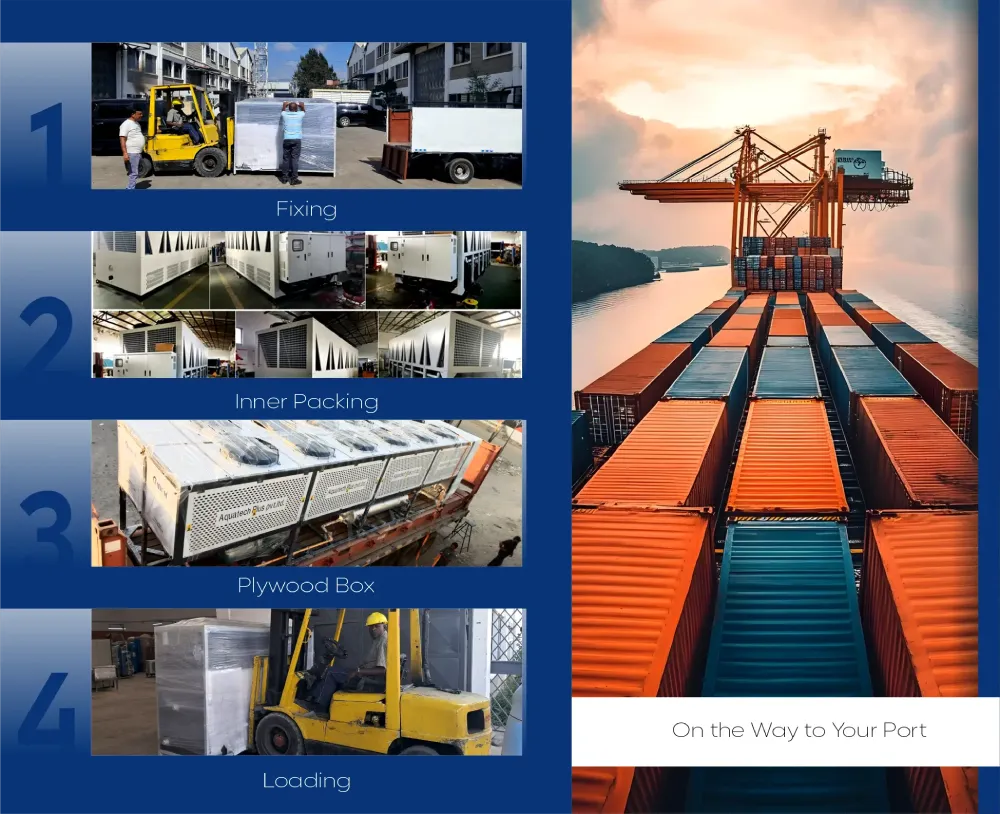
We have a uniform workflow in packaging and logistics that is export-wise, which prepares all our products except that they are safe in handling and delivery with no damages in India and other countries. Every phase is also thought out to cushion equipment against vibration, impact, and moisture risks in addition to long-distance transportation risks. The same is done to water chillers, air chillers and all other products that we produce and supply.
The process starts with mechanical repair of the unit of the product. The industrial quality fastening is used in all internal assemblies, critical parts, piping, and electrical parts. Moving components are fixed, and vibration-sensitive sites are fixed to avoid the mechanical stress during the transportation.
Objective: Avoid internal movement, vibration breakage, and alignments during transportation.
Once the repair is done the product is inner-packed with moisture-proof and shock absorbing materials. Foam padding, stretch film and cushioning materials are used as protective layers to cover all the exposed areas and all those components which are sensitive.
Objective: Dust, humidity, surface abrasion, and small mechanical shocks.
The product is packed in a specially designed heavy-duty plyboard box which is produced depending on its size and weight. The casing of the plywood is strengthened to resist the weights of the stacking, forklift operation and the transportation strain over long distances. When exporting goods, the packing is done to comply with the shipping and container loading requirements by the international community.
Objective: Optimal security on the outside and the requirements of the domestic and export logistics.
The product is loaded to the trucks with the use of cranes or forklifts, in accordance with good lifting and load-sharing practices. The delivery is then by road under conditions of control. In the case of domestic clients, the truck will go straight to the facility of the customer.
Objective: Loading and stable transportation on the road.
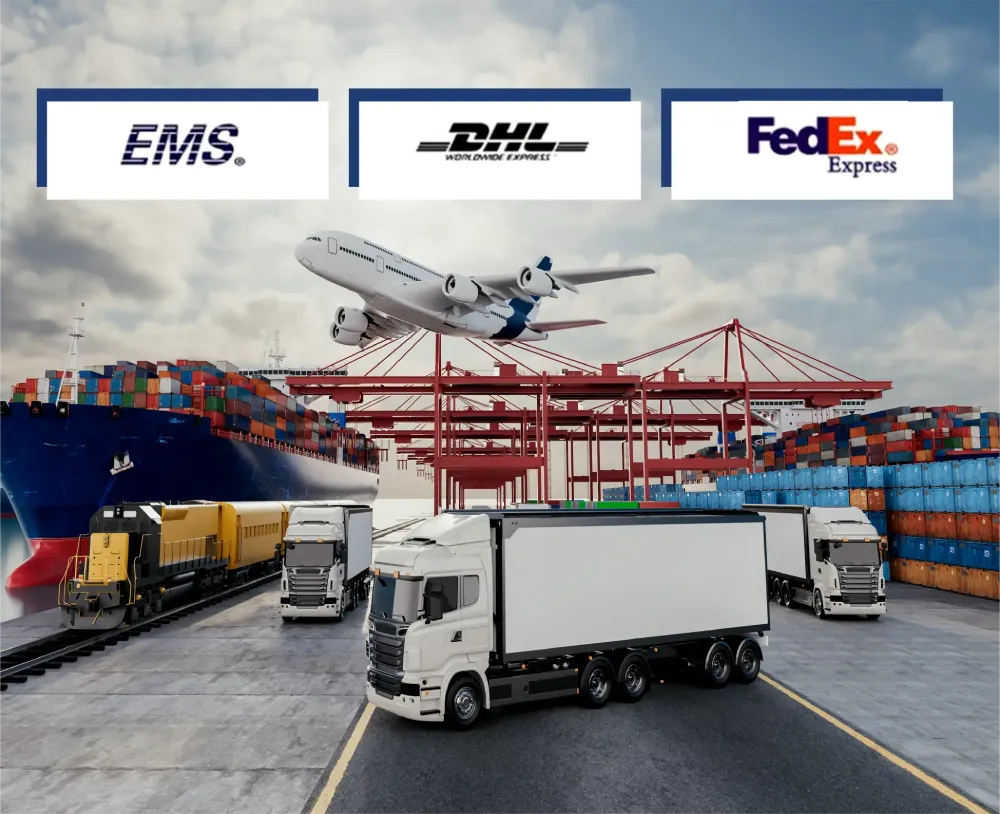
Whereas in international deliveries, the shipment is taken out of our plant to the Indian port. Pre-port entry All the export documentation, labeling and compliance checks are done before port entry.
Our logistics partners are reputable and trusted individuals like EMS, DHL Express, and FedEx Express who help us to have an easy time moving the ports and handling the exports.
Goal: The port handling and export preparation are smooth.
After clearance in the port, the product is delivered through sea freight into the destination port of the client. The packaging is to maintain a long transit period, container handling and a fluctuating weather pattern.
The international deliveries are also arranged with the help of the existing world logistics systems, the EMS, DHL Express and FedEx Express, which guarantee the safe and timely delivery.
Purpose: Achieve international delivery with low levels of transits.
A clear packaging and transportation procedure would assure that all products will be delivered to the clients in working conditions, lessen installation and commission problems, minimize the risk of transit damage, and facilitate hassle-free domestic and foreign delivery.
This is our standard operating procedure and is used in the process of packaging and transportation of all our products. Although the central process is the same, a different method can be used to pack the products, depending on the product size, weight and the destination to which the product is to be shipped.
This packaging and transportation workflow represents our standard operating process and is uniformly followed across our entire product range. The steps outlined above are not product-specific but define our company-wide logistics and export handling standards.
To maintain consistency, safety, and compliance, this process is intentionally displayed across all relevant product pages under the Packaging & Transportation section. While the framework remains the same, actual packing materials, box dimensions, and handling methods may vary depending on product size, weight, and shipment destination.
From an operational standpoint, this approach ensures:
From an SEO and documentation perspective, this section is used to clearly communicate our established logistics protocol, not to repeat marketing content. Each product page focuses on its unique specifications and applications, while this section defines our common logistics standards.





Commercial blast chillers rapidly reduce food temperature after cooking, preserving freshness, improving food safety, and meeting hygiene standards in restaurants, hotels, and food processing kitchens.
A commercial blast chiller typically cools food from 90°C to 3°C within 90 minutes, depending on food type, load size, and chiller capacity.
Blast chillers prevent bacterial growth by quickly passing through the danger temperature zone, helping commercial kitchens comply with HACCP and food safety regulations.
Modern blast chillers use optimized airflow, efficient refrigeration systems, and insulated cabinets to deliver fast cooling with controlled energy consumption.
Yes, many commercial blast chillers offer optional blast freezing, allowing food to be frozen rapidly to -18°C while maintaining texture, taste, and nutritional value.
We carry a specified warranty and effective after sales services to all goods provided by us. Our warranty and service system will be aimed at long-term performance, reliability in terms of work, and peace of mind of our clients, both domestic and international.
Every product has a standard warranty of manufacturing defects dating back to the dispatch date or the date of installation, as existing. The warranty includes the defects to the quality of material and workmanship in the normal operation condition.
There are various warranty terms based on the product category, model, application and environment of use. Specifics on warranty period and coverage are provided in detail during the confirmation of orders or issue of invoice.
Warranty is not applicable on damages caused by:
Our technical support provides our clients with instructions on how to install, answer technical questions as well as basic troubleshooting. Depending on where the project is located, support is accomplished by providing documentation, remote assistance or by organizing services with service partners.
We assist both domestic and foreign clients with well-organized contact and export documentation. In the case of international customers, technical support and service management are offered remotely to have a comfortable functioning and prompt problem resolution.
There is a process in which service requests are processed. When we get a support request, we examine the problem and determine the warranty eligibility and suggest a remedy. The response timelines can be different depending on the product, location and availability of the components.
The above warranty and support terms are the standard policy which we use in our whole product line. Particular product-level warranty information might vary and are provided independently when taking orders.
This Warranty & Support section represents our standard company-wide policy and is consistently applied across our complete product range. The content is intentionally displayed on multiple product pages to communicate uniform warranty coverage, service terms, and support procedures.
While the core policy remains the same, actual warranty duration, coverage scope, and service conditions may vary by product model, application, and operating environment. Product-specific warranty details are shared separately at the time of order confirmation or documentation.