
- Home
- About Us
- Chillers
- Industrial RO System
- Projects
- Exhibition
- Certificates
- Infrastructure
- Contact Us
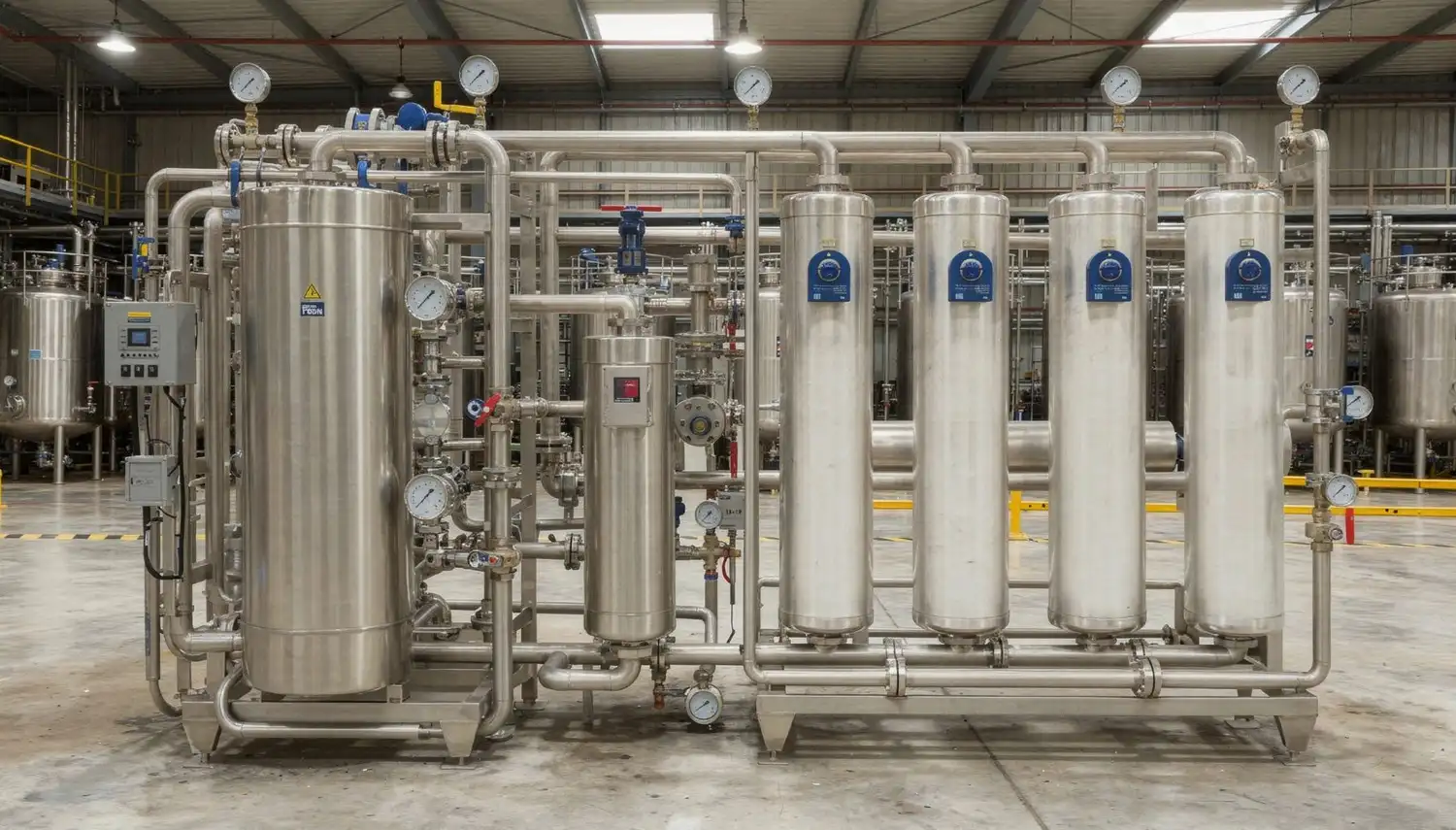
Food and beverage businesses are held to many different requirements for quality and safety. The environment we live in today prioritises consumer health, and therefore the way we process ingredients (most notably water) has changed dramatically. In fact, one of the biggest changes to the industry has been the widespread adoption of Ultrafiltration Water Systems as a primary means of purification of liquids.
Water is not just a utility in the manufacturing of food. It is also an essential ingredient and primary means of cleaning. For example, when juice is clarified or bacteria or viruses are removed from dairy, how well the filtration works impacts how long the final product will remain safe to consume. Traditional filtration methods generally do not meet today’s stringent requirements, and, therefore, the regulations manufacturers must comply with require them to seek newer technologies to employ precision filtration—which happens on the molecular level—through the use of membrane systems.
Ultrafiltration (UF) is the filtering of water using membranes that separate water from contaminants such as suspended solids, bacteria, pyrogenic bacteria (i.e., fever-producing), and large or very large molecular weight substances. Ultrafilters do not operate like reverse osmosis systems, which remove nearly all minerals from the water, but rather remove certain specific contaminants by allowing for a higher flow rate than other filtration methods. As such, Industrial Ultrafiltration Systems have a high value to large manufacturing operations, where speed and capacity are equally important as product purity.
Pushing water through semipermeable membranes with pore sizes of 0.01 to 0.10 microns allows the system to effectively block out pathogens and silt without requiring large volumes of chemical pre-treatment. Consequently, companies producing foods and beverages can offer consumers cleaner labeling and natural product profiles due to the fact that the need to use chemical additives to maintain the physical state of water has been greatly minimized.
Implementing ultrafiltration technology is not only about compliance; it’s also a key decision within your overall business strategy. The best ultrafiltration water system provides a business with the foundation for long-term, stable operations. Ultrafilters are built to withstand fluctuating turbidity of incoming source water and still produce high-quality product water.
Sustainability is an additional driving force... Today’s manufacturing businesses have to reduce their environmental footprint. One of the ways UF systems can assist with this goal is through providing high water recovery rates. The recycling of process water to be used for other functions (i.e., cooling and cleaning of equipment) can significantly reduce the amount of raw water consumed by your business and the wastewater disposal fees.
UF membranes are a physical barrier to 99.99% of bacteria and viruses.
UF supports uniformity of product by having the water used in each batch be the same; therefore, the brand taste profile is maintained.
UF modules take up less space than a sand filter or clarifier.
UF systems use fewer flocculants and coagulants during pretreatment.
Ultrafilters require less energy than either thermal separation or high-pressure RO systems.
TRIVIA
The Space Connection: Ultrafiltration technology was significantly advanced through research into water recycling for astronauts. Today, the same principles keep your favorite bottled beverages pure.
Ultrafiltration is revolutionizing dairy processors by allowing the protein content of dairy milk, cheese, and yogurt to be standardized. Milk proteins can be concentrated from milk through the use of membranes; therefore, manufacturers at these locations can produce yogurts and cheeses that have increased levels of protein, resulting in an overall increased yield of product.
Consumer juices and beverages also utilize ultrafiltration as a method of removing the haze from juices and beverages caused by pectin and protein while preserving the flavor and nutrients present in these beverages.
For breweries and/or soft drink manufacturers, ultrafiltration is utilized to ensure that the water supply has no traces of organic materials that can spoil the flavor of the final product or produce off-odours. Working with a reputable Ultrafiltration System Manufacturer allows them to create appropriate filtration stages based on the mineral composition of their water supply, ensuring the regional production of soda has the same flavor, no matter the location where it was manufactured.
| Feature | Traditional Sand Filtration | Ultrafiltration (UF) |
|---|---|---|
| Pore Size | ~10 - 20 Microns | 0.01 - 0.1 Microns |
| Bacterial Removal | Partial / Low | Complete Physical Barrier |
| Chemical Requirement | High (Coagulants) | Very Low to None |
| Footprint | Large / Extensive Space | Compact / Modular |
| Turbidity Handling | Sensitive to Spikes | Highly Resilient |
You need to have an understanding of both technical expertise and what is going on in your local industry for successful implementation. Many of the top ultrafiltration system manufacturers in India procure high-quality, durable equipment. The engineering levels within the Indian water treatment industry have progressed to meet international standards, allowing for an improved price point without compromising on the technology sophistication of membranes.
No matter how good the system is, the quality of the components will determine the overall performance and longevity of the entire system; therefore, when a procurement manager is looking for quality Ultrafiltration System Exporters In India, they will be looking for manufacturers that have experience with an international client base and can guarantee their systems have been manufactured in accordance with current standards and designed for easy clean-in-place (CIP) in facilities where hygiene is important, such as food.
The complexity of the global food supply network has increased significantly in recent years. As a result of contamination of food supplies, a single incident can trigger a huge recall, extensive damage to the brand, loss of credibility, and potential legal consequences. Manufacturers create a "fail-safe," more secure environment by implementing additional advanced UF stages throughout their production line. Modern systems provide manufacturers with the ability to completely automate their processes; therefore, they are able to monitor quality control of water in their processes as well as have documentation of water quality at all times as log data for food safety audits and certifications.
The ability of these systems to be utilized in various locations, "point-of-use" in the manufacturing facilities, makes their usage extremely beneficial. For example, whether the use of water is for the treatment of the boiler feed water to eliminate scaling buildup or the purification of the rinse water for fresh produce, UF technology provides flexibility in terms of water treatment and provides manufacturers with a more efficient process for raw resources into high-quality products.
TRIVIA
Energy Saver: Compared to thermal evaporation (boiling water to purify it), ultrafiltration can save a manufacturing plant up to 80% in energy costs for liquid separation.
Aquatech is the best industrial water treatment provider. Also, we are the most trusted and reliable partner for many businesses. Since 2014 we have been providing solutions to many industries under the direction of Mr. Husain Shersiya. Our expertise is to provide the companies with high performance and customized solutions. We also offer RO plants and water softeners and many water purification technologies that are used in modern industries. Aqua Tech Plus focuses on customer satisfaction by providing end-to-end services, including consultation, installation, and maintenance. Also, we give the sustainable solutions that meet the modern industrial demands. If you are thinking of sourcing a high-quality industrial water treatment system, then you are at the right place. We also serve cooling and heating solutions, commercial chillers, HVAC systems, and many other related products.
Ultrafiltration (UF) is a major technological advancement within the food and beverage industries, focusing on safety, efficiency, and sustainability. The impacts of these systems allow manufacturers to meet global Legionella health standards while reducing their carbon footprint significantly. The ability to provide high-quality purification with minimal chemical dependence not only protects consumers but also provides cost savings in operations. As more consumers demand greater transparency and quality from products, UF systems are considered a futuristic investment. Choosing a proven partner such as Aquatechplus will help ensure your business remains one step ahead of all regulatory changes and continues to maintain consistency and superior quality in production.
“Upgrade your production standards today with high-performance UF systems from Aquatechplus—the trusted name for industrial water excellence.”
Ans: While both use membranes, UF operates at lower pressure and filters particles based on size (0.01 to 0.1 microns), keeping essential minerals intact. RO removes almost all dissolved solids and minerals, requiring much higher pressure.
Ans: These systems act as a physical barrier that removes 99.99% of pathogens, including bacteria and viruses. This ensures that the water used in food production is microbiologically safe without relying heavily on chemical disinfectants.
Ans: In dairy, UF is used for protein standardization. It allows manufacturers to concentrate milk proteins while removing lactose and water, leading to higher yields in cheese and yogurt production.
Ans: Yes. A professional manufacturer will design a modular system based on your specific feed water quality, required flow rate, and the specific sensitivity of your food or beverage product.
Ans: Aquatechplus is a leading name among Indian manufacturers, known for engineering high-durability systems that meet international food-grade standards and hygiene requirements.
Ans: Reputable exporters like Aquatechplus provide end-to-end services, including installation, technical training for your staff, and "Clean-in-Place" (CIP) maintenance protocols to ensure system longevity.
Ans: Because UF uses physical separation rather than chemical additives like flocculants or coagulants to clarify liquids, manufacturers can market their products as having fewer chemical ingredients.
Ans: Not at all. Modern UF systems are designed for automated backwashing and easy CIP cycles. This reduces downtime and ensures the membranes stay clear of organic fouling with minimal manual labor.