
- Home
- About Us
- Chillers
- Industrial RO System
- Projects
- Exhibition
- Certificates
- Infrastructure
- Contact Us
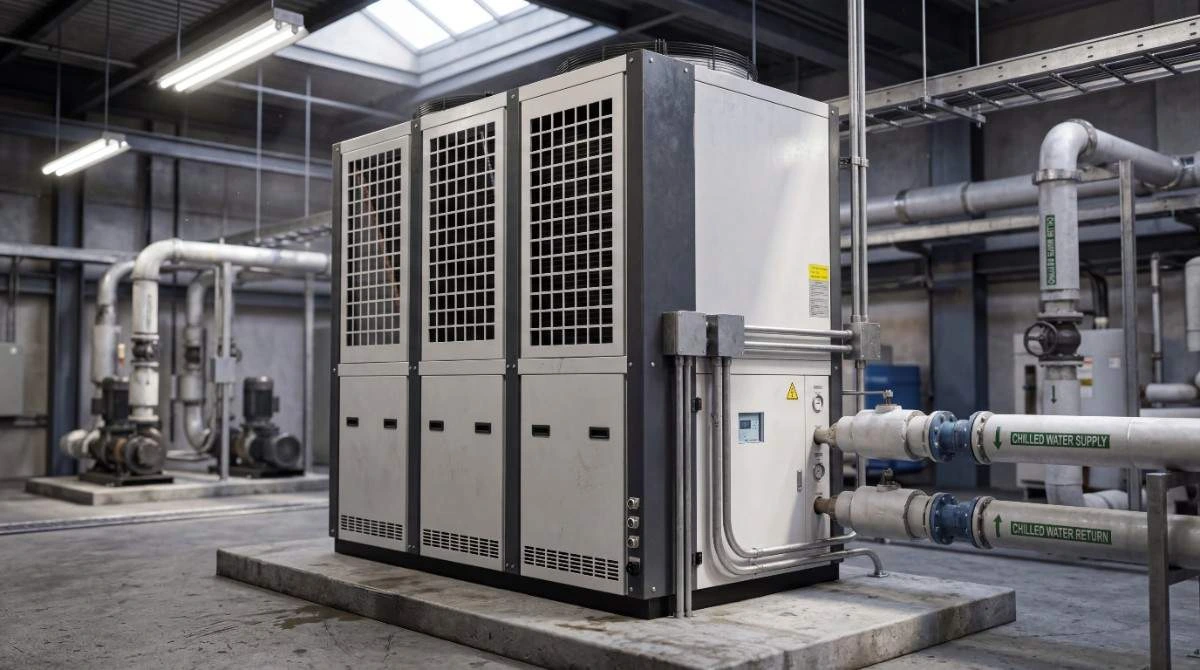
Today, there is an ever-increasing demand for efficiency in industrial backgrounds. In the heart of India’s rapidly evolving industrial landscape, the demand for efficiency has never been higher. The traditional cooling systems consumed high power. This did not depend on the actual load. Today, the leading inverter scroll chiller manufacturers offer smarter products with the latest technologies.
Why inverter chillers work in a better way is because these chillers have become smarter. Whether you want to buy large screw chillers for high-performance tasks or smaller ones for lighter tasks, understanding what all benefits are associated with the chillers is vital.
In simple terms, an inverter scroll chiller is used to control the compressor motor. It takes the help of a multi-speed drive to complete its task.
Let us try to understand the working of inverter chillers with the following example. Picture traditional chillers as light switches. When the space gets cooled, the switch shuts down and goes back up again when the temperature in the room rises.
Now consider inverter scroll chillers as a dim switch. It slows down to a position where it matches the temperature of the room and does not switch off completely. If your industrial machines run at half speed, so does the chiller. This saves a lot of electricity that was earlier getting wasted.
The first thing that you have to pay attention to when investing in chillers is making a decision. Recognize what your requirements are. Let us look at the basic differences between the two types of chillers.
These chillers use fans to blow air present in the space across the copper tubes. This process disperses heat, thus cooling down the system.
Advantages of air scroll chillers:
Air-cooled inverter scroll chillers that come with inverters are more efficient, as they help the fabs to change their speed (increase or decrease) depending on the outside temperature.
These chillers use water to cool down the system.
Through the following table, let us try and understand what to expect from a high-performance chiller.
Technical Data: FIDEM Inverter Scroll Chiller Series
| Parameter | Unit | Specification |
|---|---|---|
| Chiller Type | — | Inverter Scroll Chiller |
| Cooling Method | — | Air Cooled / Water Cooled |
| Cooling Capacity Range | kW | 10 – 200 |
| Capacity Control | % | 20 – 100 (Stepless, Inverter Driven) |
| Temperature Control Range | °C | 5 – 25 |
| Temperature Stability | °C | ±0.2 |
| Cooling Medium | — | Water / Water + Glycol |
| Refrigerant Type | — | R134a / R407C / R410A |
| Compressor Type | — | Inverter-Driven Scroll |
| Compressor Start | — | Soft Start (Inverter) |
| Compressor Brand | — | Copeland / Danfoss / Panasonic |
| Power Supply | — | 3 Phase, 380–415V, 50Hz |
| Input Power Range | kW | 3 – 45 |
| Condenser Type | — | Air: Finned Copper Tube / Water: Shell & Tube |
| Evaporator Type | — | Shell & Tube / Plate Heat Exchanger |
| Chilled Water Flow Rate | m³/h | 2 – 40 |
| Noise Level | dB(A) | ≤ 62 |
| Control System | — | PLC / Microprocessor |
| Communication | — | RS485 / Modbus (Optional) |
| Safety Protections | — | HP/LP, Overload, Phase Loss, Flow Switch, Anti-Freeze |
| Installation Type | — | Indoor / Outdoor |
Traditional chillers go through a gush of electricity whenever the compressor starts. Whereas in a scroll chiller, the electricity does not surge suddenly. It starts slowly, thus reducing huge electricity bills. Energy efficiency is the primary reason for a large number of industries to prefer inverter chillers.
Various industries, like food, pharma, etc., require working under strict temperature conditions. A discrepancy of even 1.5°C can ruin the entire operation and production. Temperature stability is another vital factor separating inverter chillers from the traditional ones.
In some of the inverter chillers, like the screw chillers, the frequent starting and stopping of the machine is a major cause of mechanical issues. Whereas in an inverter scroll chiller, the internal parts do not experience a lot of friction since they do not completely shut off and run at lower speeds.
Various industries come under the strict regulations of noise pollution. Traditional chillers used to make loud noise while operating. This is not the case for inverter chillers.
Finding the right inverter scroll chiller manufacturers is as important as choosing the right product. At Aquatech Plus, we deal in a wide range of cooling systems, including industrial chillers, glycol chillers, comme
On average, modern factories see an energy reduction of 30% to 50% when switching from a traditional fixed-speed system. Because inverter scroll chillers avoid the massive power "surges" during start-up and can operate as low as 20% capacity during off-peak hours, the cumulative savings on electricity bills are significant.
Yes. While a screw chiller is excellent for very high-capacity industrial cooling (usually above 200 kW), inverter scroll chillers are often superior for small to medium loads (10–200 kW). They offer better precision and energy efficiency at part-load conditions, making them ideal for facilities where cooling demands fluctuate throughout the day.
Actually, the opposite is often true. While they do have more sophisticated control systems, the "Soft Start" technology significantly reduces mechanical stress on the compressor. By avoiding the constant "on-off" cycling seen in traditional models, there is less wear and tear on the internal components, often leading to a longer overall lifespan for the machine.
Absolutely. Modern air-cooled scroll chillers are designed to operate efficiently even in high ambient temperatures. When equipped with an inverter, the system can adjust fan speeds and compressor output in real-time to maintain a temperature stability of ±0.2°C, ensuring your process stays cool even during peak Indian summers.
Leading inverter scroll chiller manufacturers use these refrigerants because they are more eco-friendly and offer better thermodynamic properties. These gases allow the chiller to achieve higher cooling capacities with less energy, helping your facility stay compliant with environmental regulations while maintaining peak performance.