
- Home
- About Us
- Chillers
- Industrial RO System
- Projects
- Exhibition
- Certificates
- Infrastructure
- Contact Us
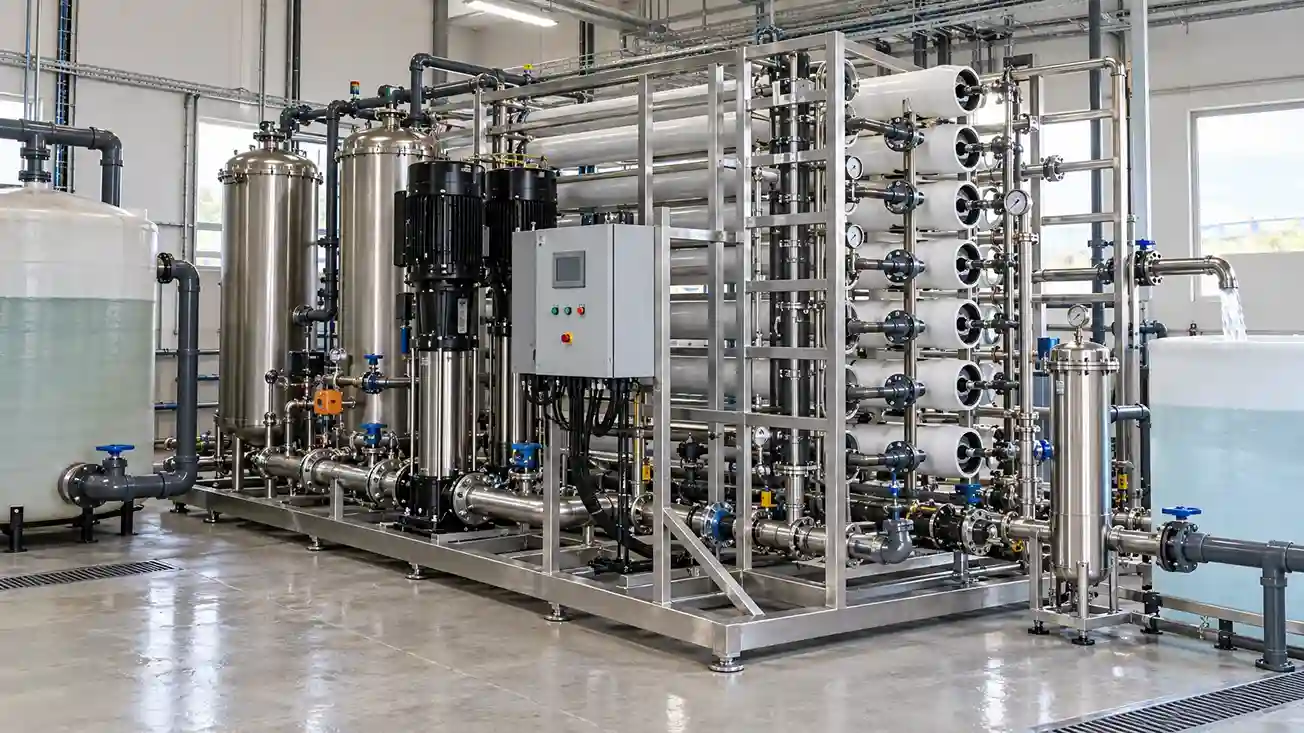
Suitable for demanding industrial applications if your source water has a high concentration of dissolved salts and minerals then an industrial water treatment system is your solution. A salt water RO plant will reduce the scale forming ingredients in feed-water to help prevent scaling and build up of minerals.
When selecting your industrial RO system you will need to look further than the size of the flow rate, the feed-water quality, the salinity, and the type of membrane used, as well as the system's recovery rate and its potential impact on membrane cleaning and power requirements.
A salt water reverse osmosis plantis a water-treatment plant capable of removing salts, minerals, and other impurities from water that contains high concentrations of salt and other impurities. By applying a pressure to the salt water through a semi-permeable membrane that is capable of allowing water molecules to pass and not many impurities, the salt water becomes filtered with the collection of permeate.
The salt water RO plant is generally designed with higher salt content feed water and plant membranes and an operational system designed to handle this salt load.
| Historic Fact: “Reverse osmosis developed from earlier membrane-separation research and became increasingly important for desalination during the 20th century. Advances in membrane technology later made RO a practical option for treating saline and high-TDS water.” |
The salt water RO plant working process include the following steps:
This sequence enables an industrial RO system from a reliable source like Aqua Tech Plus to provide uniform and pure water.
Prior to a buyer who is thinking for salt water RO plant selection system, these are the primary technical and commercial considerations to take into account:
This allows the salt water RO plant to be suitable for the given industrial RO system application.
Salt water analysis prior to choosing a salt water RO plant is important as the performance and lifespan of the membranes are significantly impacted by the feed water quality. Standard analysis parameters would be:
With the results, appropriate pretreatment, membrane type and system working conditions can be established.
Know your needs calculating the necessary RO plant capacity assists buyers in selecting a system capable of handling current and future water requirements. Think about:
An industrial salt water RO plant is designed to have capacity for treatment without being drastically over sized.
The right RO pre-treatment system from trustworthy sources like Aqua Tech Plus assists in the prevention of membrane scaling, fouling and early performance loss. Typical stages consist of:
These processes precede membrane treatment and help to ensure the reliable operation of an industrial water treatment system.
When shopping around for the ideal RO membrane, the buyer should look for:
A well-designed salt water reverse osmosis plant can be operated reliably, providing steady filtration and stable treated-water quality.
Operating costs of an RO plant stem from its operational efficiency. When selecting an automatic industrial RO system system, buyers can review:
An energy-efficient RO plant with the right automation can keep your power usage and operating cost in check like Aqua Tech Plus.
|
Myth: “A salt water RO plant only removes salt. Fact: RO membranes can also reduce many dissolved minerals and other contaminants, although the actual removal depends on membrane characteristics and feed-water conditions.” |
With an industrial salt water RO plant, they can provide water-treatment solutions to industries that require the treatment of water that contains salt or high TDS content. These are some of the applications of water treatment that make them suitable across various industries. These industries below are RO plant applications:
These applications allow RO systems to be useful in all kinds of industrial settings.
It is important to understand the advantages of using a salt water RO plant in the context of the specific requirements of the industry or process. The main salt water RO plant benefits are:
An industrial RO system from Aqua Tech Plus enables more well-organized and reliable water control.
|
Read Our Related Blog to Learn More: |
Using a RO plant with a consistent level of operation reduces the potential for unplanned down-time. Proper and thorough RO plant maintenance should include:
Performing these practices as part of your industrial RO system maintenance will ensure longevity of your equipment.
To select your salt water RO plant, you must match feed-water quality, treatment capacity, pre-treatment needs and membrane types with the specific industrial needs. Also, considering operating and maintenance costs over the long-term is essential.
The ideal salt water reverse osmosis plant will ensure stable water treatment, optimal operation, and for an industrial RO system you need to find a professional reverse osmosis plant supplier like Aqua Tech Plusto match your water treatment needs.
A salt water RO plant uses reverse osmosis membranes to remove dissolved salts, minerals and other impurities from saline water, producing treated water for various applications.
It uses pretreatment, high-pressure pumping and RO membrane separation to separate dissolved contaminants from water. The treated water is collected as permeate, while concentrated impurities leave as rejected water.
Consider feed-water quality, TDS, required capacity, pretreatment, membrane compatibility, energy consumption, maintenance needs and overall operating costs.
They are used in manufacturing, food and beverage, pharmaceuticals, power plants, hotels, coastal facilities, marine operations and other process industries.
Maintenance frequency depends on feed-water quality and operating conditions. Regular membrane cleaning, filter replacement, pressure monitoring, chemical dosing and water-quality checks are important.
Aqua Tech Plus can be considered for industrial water-treatment requirements. Buyers should discuss their feed-water quality, required capacity and application with the company to determine a suitable RO configuration.