- Home
- About Us
- Chillers
- Industrial RO System
- Projects
- Exhibition
- Certificates
- Infrastructure
- Contact Us
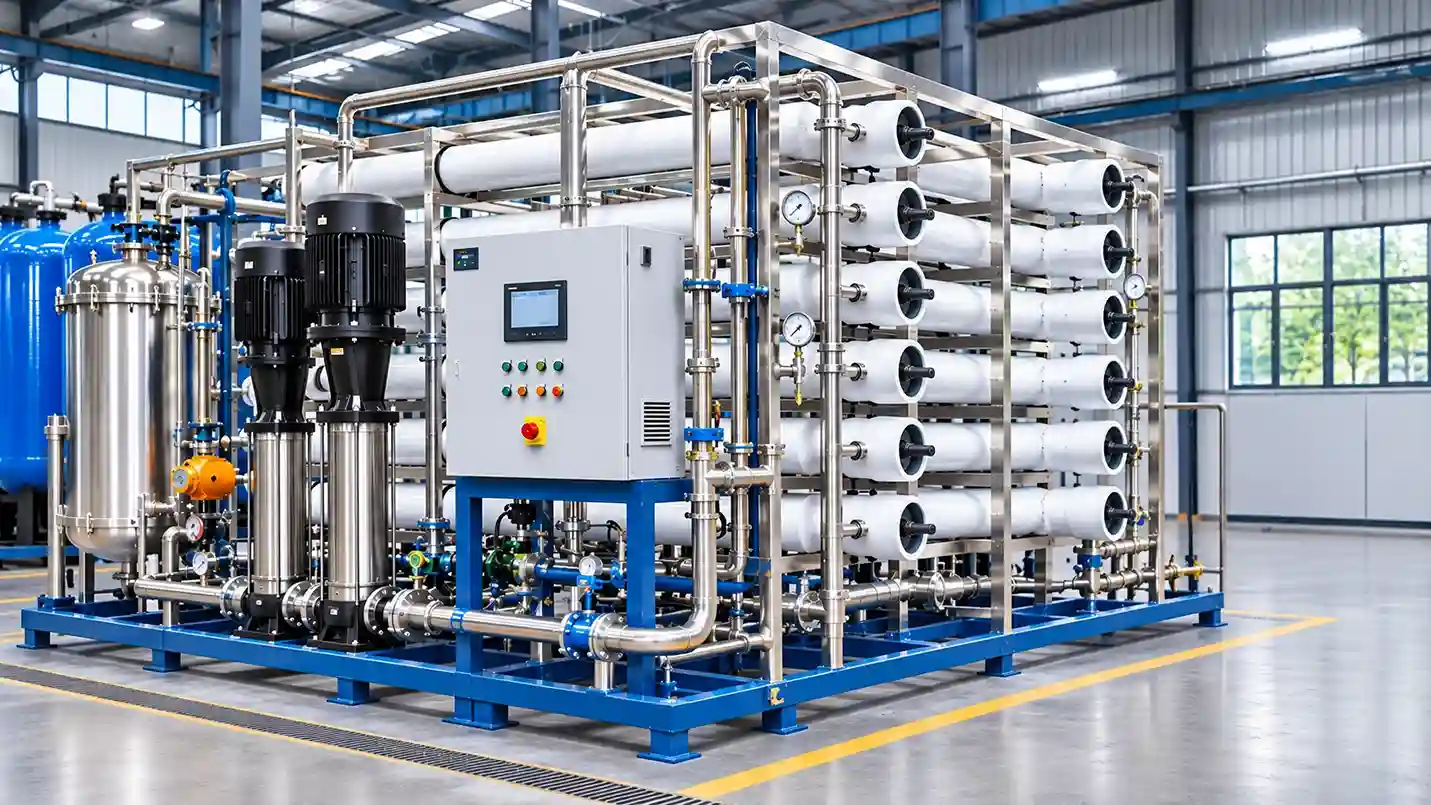
An industrial RO system removes all dissolved salt, minerals and impurities from the water. It helps industries to ensure the level of water purity required for various processes and manufacturing. Industrial RO plant cost depends on treatment capacity, feed water quality, system design and operating condition and is subject to change. These are the things that business owners should look at before they decide to invest.
An industrial reverse osmosis system is a system that uses a semi-permeable membrane to filter impurities and salts from water. The feed water flows through multiple pre-filtration units and then is fed into the reverse osmosis membrane where it is pressurized. Reverse osmosis membranes permit the water molecule to flow through but blocks most of the dissolved solids.
The filtered water, or permeate, is collected for industrial use and the rejects are disposed of in the concentrate stream. Reliable water quality for production, cooling and processing is provided by industrial water purification systems to industries.
The complete industrial RO plant price will vary depending on the design of the plant, treatment needs and installation conditions. The factors that impact the original investment include:
All the above mentioned factors affect the industrial RO system cost which needs to be seen before overspending or investing in bad quality.
Industrial RO plant capacity is in litre/hour (LPH), million litre /day (MLD). A 1000 LPH RO plant will have a different set of equipment than a higher capacity system. Higher the capacity, higher will be the number of membranes, pumps, pressure vessels, storage and accessory equipment, thus resulting in higher industrial RO plant price for the system. Always choose a capacity as per your actual water requirement rather than oversize the plant.
Feed-water quality impacts RO plant design and operation. TDS, hardness, suspended solids, and other contaminants are factors that can be determined via water testing. You can then select the appropriate RO plant pretreatment system, such as sand filtration, activated carbon filtration, and water softening to prevent membrane fouling and scaling, which protect equipment, maintain stable operation and manage the long-term cost of an industrial water treatment plant.
The following table talks about the technical specifications of the industrial RO system.
| Technical Parameter | Description |
|---|---|
| Treatment Capacity | Amount of water purified per hour, generally measured in LPH or MLD. |
| Feed Water TDS | Total dissolved solids present in the incoming water. |
| Permeate Flow Rate | Volume of purified water produced by the RO system per hour. |
| Recovery Rate | Percentage of feed water converted into purified water. |
| RO Membrane Type | Membrane selected according to feed-water quality and treatment requirements. |
| Operating Pressure | Pressure required to push feed water through the RO membranes. |
| Salt Rejection Rate | Percentage of dissolved salts rejected by the RO membrane. |
| Power Consumption | Electricity required to operate pumps and other system components. |
| Pretreatment System | Filtration and conditioning equipment used to protect RO membranes. |
| Control System | Manual or automatic controls used to monitor and operate the plant. |
| Material of Construction | Materials used for pressure vessels, pipelines, tanks, and equipment. |
| Product Water Quality | TDS and other water-quality parameters of the treated water. |
When buying an industrial RO plant, it is important to compare technical specifications of the products, not just the price quoted for each. Critical specifications include permeate flow, recovery, number of membranes and layouts, operating pressure, product-water quality. The industrial RO system specifications including the permeate specifications and feed-water temperature should meet application requirements. Check energy consumption, pump efficiency, automation and control arrangements.
The purchase price is not the entire investment for an RO plant. Underlying industrial RO plant operating cost is electricity, replacement of filter cartridges, cleaning chemicals and routine maintenance. Regular cleaning and eventual replacement of membranes also will be needed depending on operating conditions and water quality.
RO membrane replacement cost is also an important factor to consider when drafting budgets. Routine maintenance, scheduled and preventive service, should avoid unexpected product downtime. Companies should also factor in productivity loss due to downtime of their equipment when calculating the total cost of ownership of their industrial RO system.
Experienced industrial RO system manufacturers like Aqua Tech Plus are an ideal choice to purchase the system as they make equipment according to industrial need. Buyers should check technical expertise, project experience and ability to customise systems as per feed water quality and flow rate. Some questions to ask before choosing a provider are:
An analysis of different industrial RO plant manufacturers and industrial RO system suppliers like Aqua Tech Plus helps the purchaser in making a better decision.
| Historic Fact: The Evolution of Reverse Osmosis Technology: “Reverse osmosis technology gained significant attention in the 1950s when researchers explored membrane-based methods for desalinating seawater. In 1959, scientists at the University of California, Los Angeles (UCLA), developed an important breakthrough in practical salt-rejecting membranes, helping advance modern RO water purification systems.” |
Achieving best value quotations should be compared in relation to similar equipment specifications and technology. Attention should be paid to treatment capacity, recovery, energy usage, pretreatment and maintenance costs.
Initial industrial RO plant cost may be less economical if operating costs are higher; it is important to compare the overall cost over the intended lifespan of the plant. Request an industrial RO system quotation that includes equipment, installation, commissioning and warranty conditions.
Choosing reliable industrial RO plant suppliers like Aqua Tech Plus help to get the best value and result looking for long-term performance.
A comparison of quotes is just the beginning. For an industrial RO system, buyers need to look at the capacity, feed-water quality, technical parameters, power consumption, and maintenance cost of the industrial RO system. And industrial RO system manufacturers with experience to choose the right system and make the system run better. Learn more about Aqua Tech Plus's industrial RO system!
The industrial RO system cost depends on a number of factors such as plant capacity, feed-water quality, necessary pretreatment, automation, membrane selection, and the installation costs.
While buying industrial RO plant need to compare capacity, quality of feed water, recovery rate, power consumption, membrane design, maintenance and warranty. All these industrial RO system specifications ensure long-term performance.
The need for industrial RO membrane replacement depends on the feed-water quality, quality of pretreatment, operational and maintenance conditions, etc. Replacement requirements are assessed through regular monitoring of the system. With proper industrial RO maintenance help to lead the best and continue performance.
While choosing industrial RO system manufacturers need to check the manufacturer's technical skills, manufacturing experience, tailor-made product selection, up-front quotation, warranty term and aftersales service after you make a decision.
The optimal recovery rate can vary depending on feed-water quality, the configuration of the membranes, whether the feed water is likely to cause scaling, and the quality of permeate desired.
Our business is focused on providing effective water treatment for industrial processes, clean and sterilised water as well as cooling and waste water solutions.