
- Home
- About Us
- Chillers
- Industrial RO System
- Projects
- Exhibition
- Certificates
- Infrastructure
- Contact Us
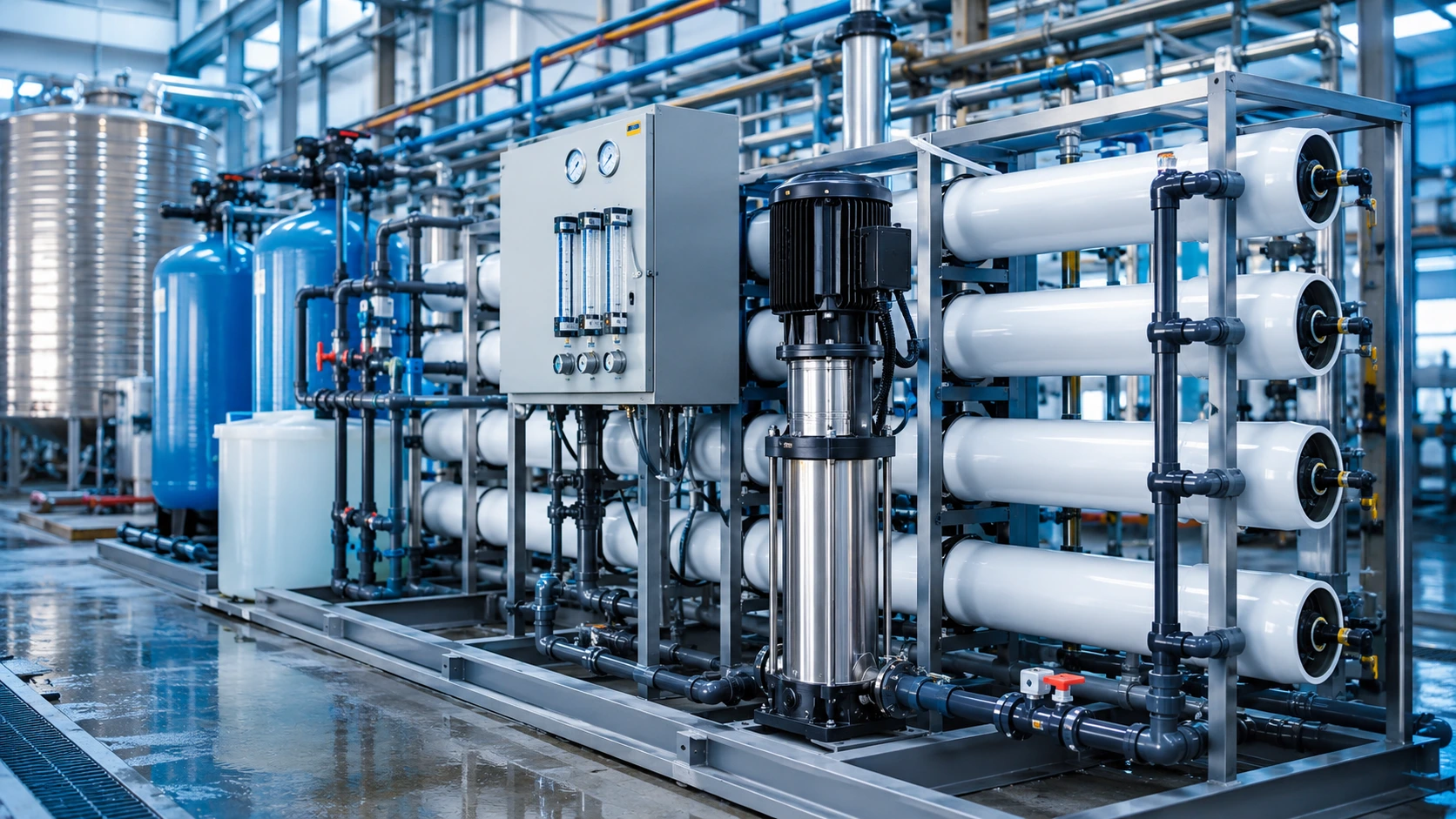
A working guide to running reverse osmosis systems without the surprise repair bills.
Buy an Industrial RO Plant and you've made a real investment in your plant's water quality. Skip the maintenance, though, and that investment starts losing value fast. Most operators don't notice the slow stuff. Pressure creeps up a little. Output drops a little. Nobody flags it until the membrane is already scaled beyond saving, and by then you're not maintaining an Industrial RO System anymore, you're replacing one.
This piece covers the basics that actually matter: what these plants do, which type suits your operation, what to check before buying, and the habits that keep an industrial ro filter system running the way it's supposed to. If you're running a bottling line, a pharma unit, or a food plant, none of this changes much.
Strip away the branding and an Industrial RO Plant is just a big Industrial Water Purification System built to force raw water through membranes fine enough to block salts, bacteria, and suspended solids. It's not the same animal as a kitchen counter purifier. These units run continuously, often unattended, and lean on multi-stage pretreatment plus high-pressure pumps to keep the membranes fed with water they can actually handle.
Did You Know: one fouled membrane element, just one, can quietly knock a third off a plant's output before anyone even checks the gauges.
Water isn't consistent. It changes with the seasons, with the borewell, with whatever's happening upstream. Skip RO Plant Maintenance and you'll see scaling build on the membrane, pressure climb to compensate, and your power bill follow right along. Push an Industrial Reverse Osmosis System too far past its service window and the membrane damage stops being reversible. What should've been a cheap fix turns into a full replacement.
There's no single "right" setup here. Reverse Osmosis Water Treatment systems get chosen based on how much water you actually need, what source you're pulling from, and how hands-on your team wants to be day to day.
Don't just look at the capacity rating on an Industrial Water Treatment System and call it done. What's inside the skid decides how long the thing actually lasts.
Trivia: reverse osmosis wasn't built for factories first. It started as a way to desalinate seawater, long before anyone thought to put it on a shop floor.
Most industrial ro water filter system builds today come modular. That means you add capacity later instead of tearing out the whole unit when demand grows. A standard package usually bundles the pretreatment filters, dosing setup, pumps, and membrane housings onto one skid, which speeds up installation considerably compared to sourcing everything separately.
A lot of the better RO Plant Manufacturers in India back these systems with proper Annual Maintenance Contracts now, genuine spares, and support you can actually call when something's off. That matters more than people expect. A well-engineered system still needs someone watching it.
Fact: quite a few plants quietly reuse RO permeate for cooling towers or washdown jobs. It trims fresh-water use more than most people expect, once someone bothers to set it up.
| Maintenance Aspect | Manual System | Semi-Automatic System | Fully Automatic System |
|---|---|---|---|
| Monitoring frequency | Multiple checks daily | Once or twice daily | Continuous, sensor-based |
| Operator involvement | High | Moderate | Low |
| Chemical dosing control | Manual adjustment | Partly automated | Fully automated |
| Membrane cleaning alerts | None built in | Basic indicators | PLC-driven alarms |
| Best suited for | Small batch work | Mid-size facilities | Large, continuous-duty plants |
Incorporated in the year 2014, Aquatech Plus Private Limited is a known name in the business of manufacturing industrial chillers and various cooling solutions. With Director Husain Shersiya and his team of well-qualified professionals and industry experience of 17+ years, the firm caters to innovation, efficiency and dependable engineering solutions, providing bespoke cooling and water purification systems that suit a wide variety of industrial processes. In order to be able to undertake cross-border business and provide the finest international services, the company has set up offices in India, UAE, Oman and Kenya. The company has made a mark for itself as a trusted supplier of efficient, long-lasting, industrial cooling systems through its quality manufacturing, sound engineering and customer-centric solutions.
An industrial ro filter system that's properly maintained costs less over time. Simple as that. Get the design right, stay disciplined about upkeep, and you're looking at a decade of reliable service instead of one repair call after another. New install or existing setup, it doesn't matter, the same rule applies: maintenance done on schedule beats maintenance done in a panic.
An Industrial RO Plant is really only as good as the habits built around it. A five-minute pressure check today saves a much longer conversation with your maintenance team next month.
Planning a maintenance schedule, or thinking about an upgrade? Talk to a water treatment specialist. Aquatech actually look at your setup and tell you what it needs.
Depends where your water's coming from. Borewell feed chews through components faster than municipal supply ever will. Weekly pressure checks if your schedule allows it, membrane cleaning every couple months, a full inspection twice a year, no exceptions. Skip that for even one quarter and small wear turns into a replacement bill nobody saw coming.
Usually the numbers move before anyone says anything. Output slips, feed pressure ticks up trying to compensate. Sometimes someone on the floor just mentions the water tastes off, and that is reason enough to check it that day, not next week. Do not let a hunch sit until next month.
Your own team can usually handle routine cleaning, as long as they know which solution matches the fouling you are dealing with. Beyond routine? Bring in someone who does this for a living. Wrong chemical concentration or too much soak time doesn't just fail to clean the membrane, it ruins it, permanently, no do-overs.
Membranes run three to five years typically, sometimes less if your water is particularly harsh. Pumps and housings, though, can keep going a decade plus without much fuss. What actually determines lifespan is not the brand stamped on the unit. It is whether anyone bothered to maintain the cheap system versus neglecting an expensive one.
A bit of top-up, fine, hard water demands that. Constant refilling despite correct dosing settings is a different story entirely. That points somewhere specific: a dosing pump malfunctioning, concentration mixed wrong, or pretreatment failing to strip hardness before the membrane ever sees it. Water's rarely the actual culprit here.
Most credible ones, yes. Annual Maintenance Contracts covering inspections, spare parts, and scheduled technician visits are fairly standard now. What is not always clear upfront is whether genuine membranes fall under that contract or get billed separately down the line. Ask that question directly before signing anything, it saves arguments later.