
- Home
- About Us
- Chillers
- Industrial RO System
- Projects
- Exhibition
- Certificates
- Infrastructure
- Contact Us
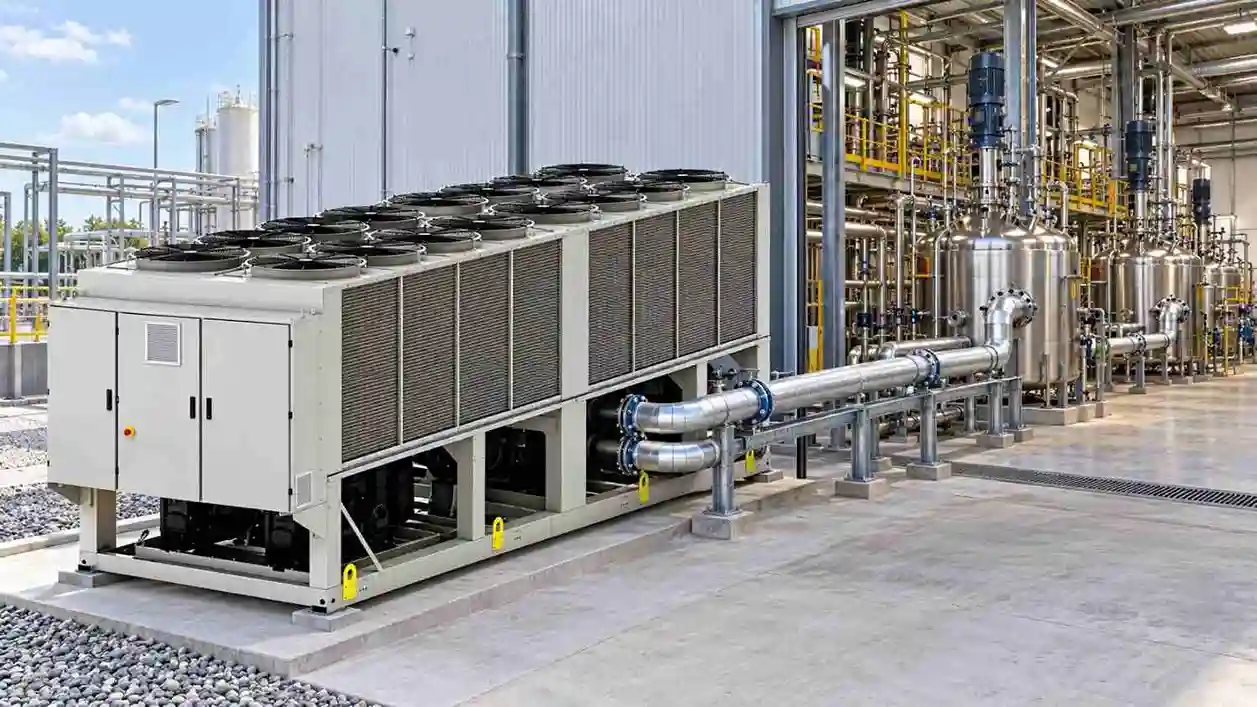
Using the heat from chemical processes generated through chemical reactions, blending, Condensate, and more manufacturing processes to produce some heat. The industrial chiller supplies the cooling water at the desired temperature to help reduce the heat from the equipment. An industrial chiller for chemical industry provides process stability, consistent quality, and assured efficiencies on equipment. Make sure what the required system should be: process temperature, flow rates, and cooling capacity.
The temperature of a circulating cooling liquid is reduced by an industrial chiller and the energy that is captured is then transferred to a different substance, which is rejected. In the example of a chemical plant, the chilled medium is sent to a heat exchanger or jacketed reactor where it draws heat from the process.
These systems often have a separate cooling fluid and chemical process fluid, which generally do not mix with each other. The cooling fluid is supplied by water or water-glycol as required. The chiller can control the temperature by means of a refrigeration and control system. Process cooling systems help regulate temperature spikes as well as save temperature-sensitive chemicals and maintain other chemical process chiller conditions.
An industrial chiller for chemical industry helps to support some manufacturing phases from reaction temperature control to the chilling of the finished products. The required amount of industrial cooling systems capacity and temperature depends on the process, materials and the operational conditions.
Reactions can also generate significant quantities of heat that must be removed to promote quality and safe production. Chemical reactor cooling can be accomplished through the use of chilled water passing through jackets or coils or by means of external heat exchangers. Other than removal of the reaction heat, a chemical process chiller can also be used to control fluctuating heat loads.
Other blending tanks may require cooling if the temperature is likely to increase during mixing. In such cases, temperature control with system capacity should be considered.
Vapours formed in a number of chemical operations need to be condensed prior to recovery or reuse. The heat input using chilled fluid to a condenser can be used to condense vapours where this temperature is achievable. A chiller for solvent recovery can be used if the condensing temperature is achievable within the system.
The recovery of solvents will reduce the waste streams produced with some positive impact on resources but before adopting it there should be due consideration regarding required temperature, vapour characteristics, compatibility of solvents to be recovered with the condenser load etc.
A product may need to be cooled after a reaction, or mixing process to be stored, packaged, or prepared for later processing. Chemical process cooling needs the temperature of a product to be lowered with controlled precision. The crystal size, yield and purity of the crystallisation process all relate directly to the rate at which the product is cooled. To achieve the right cooling curve, a crystal industrial chiller can be used, taking into account product characteristics, rate of heat removal and process duration.
Right industrial chiller advantages are not just about taking away heat. Manufacturers who depend on chemical production and on the stable environment that industrial chiller benefits provide.
Industrial cooling systems are to be specified at actual process loads. Good housekeeping, clean heat transfer surfaces, correct fluid quality, controls and regular maintenance are imperative to ensure both reliable operation and best energy performance.
There are several alternatives to select but the selection would be based on the heat rejection capacity, available utilities, operating temperature constraints and site constraints. Here are some chiller types need to know:
The buyer should compare the alternatives by looking at the following; supply temperature required, ambient conditions, utility requirements, ease of maintenance and the overall costs of operating.
Industrial chiller selection decides on the right system based on your process and plant environment. Make sure you consider the following before contacting industrial chiller manufacturers like Aqua Tech Plus:-
The finest method of narrowing down a chiller for process rather than just overall capacity is speaking to any known manufacturers.
Industrial chillers control the heat of final-product, crystallisation and solvent recovery, and maintain the cool down of reactors. Selecting the correct system can ensure product consistency, minimise deviation and maximise production time. To find the ideal fit for your requirements, know the cooling load, optimum temperature, fluid compatibility and site conditions.
Learn more about your Aqua Tech Plus application and view the industrial chiller manufacturers to explore their products. |
Industrial chillers remove excess process heat and maintain controlled temperatures, supporting consistent chemical reactions, product quality, and reliable production.
A chiller supports chemical reactor cooling by circulating cooled fluid through a reactor jacket or external heat exchanger, removing reaction heat without directly mixing with process chemicals.
| Feature | Air-Cooled Industrial Chiller |
Water-Cooled Industrial Chiller |
|---|---|---|
| Heat rejection | Releases heat into the air | Transfers heat to water |
| Water requirement | Usually no cooling water required | Requires a water supply |
| Installation | Simpler installation | Requires additional equipment, such as a cooling tower |
| Maintenance | Generally simpler | Includes water treatment and system maintenance |
| Best suited for | Plants with limited water availability | Plants with suitable water utilities and higher cooling demands |
A glycol chiller is useful when lower temperatures or freeze protection are required, provided the fluid concentration and system design are suitable.
Industrial chiller capacity depends on calculated process heat load, target supply and return temperatures, flow rate, peak demand, and operating conditions.
Buyers should ask industrial chiller manufacturers about application suitability, capacity at specified conditions, fluid compatibility, commissioning, spare parts availability, maintenance, and after-sales service.
Consider Aqua Tech Plus based on its product suitability, technical support, system performance, maintenance requirements, and service availability.