
- Home
- About Us
- Chillers
- Industrial RO System
- Projects
- Exhibition
- Certificates
- Infrastructure
- Contact Us
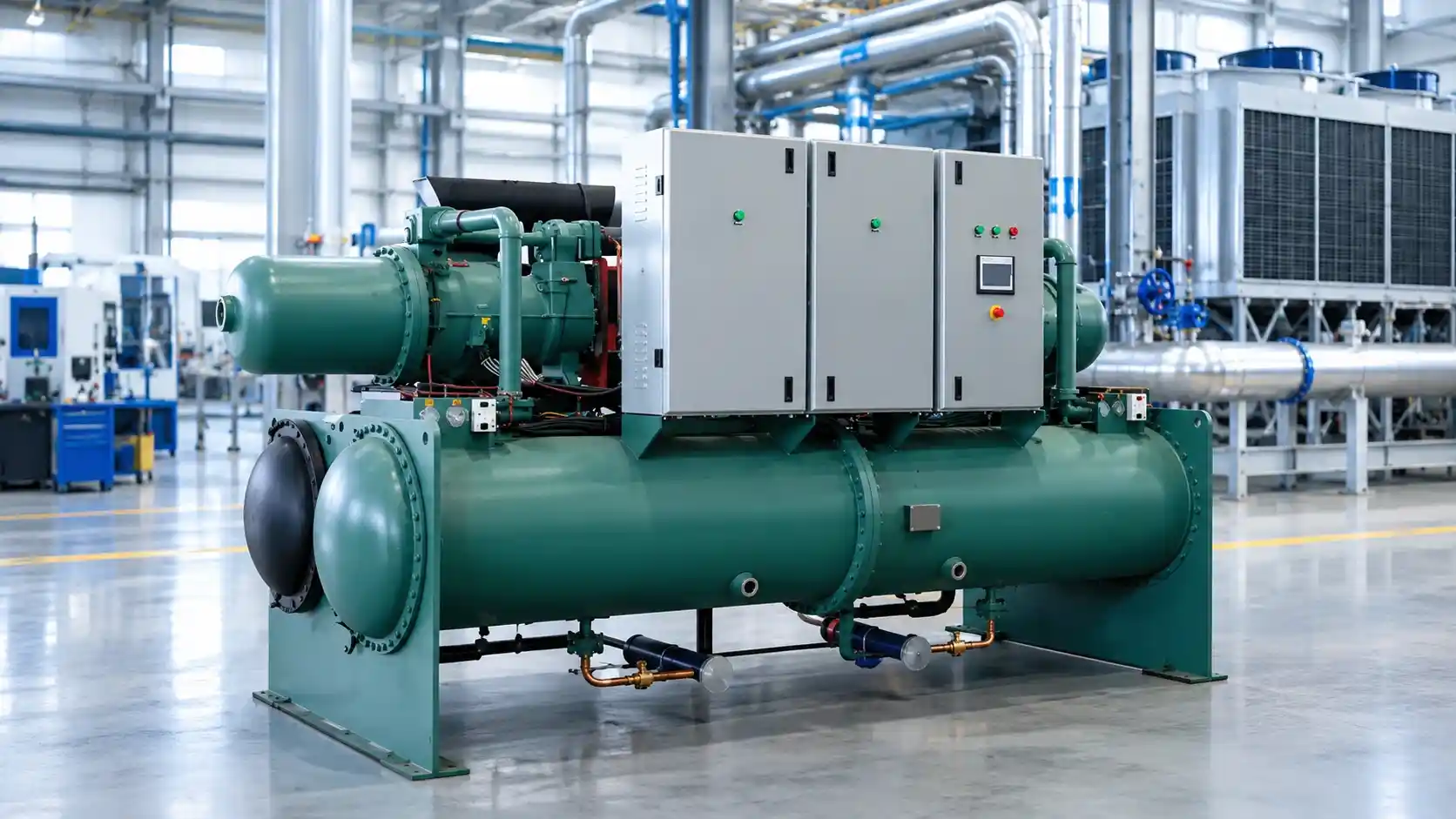
You can utilize industrial water chillers to maintain your manufacturing process temperatures at the right level. A good water chiller can improve temperature maintenance, simplify production and save operating cost. Buyers need to take into account cooling capacity, power efficiency, space for installation, maintenance requirements, and vendors' assistance before making a purchase. This allows you to buy the right industrial water chiller for your needs.
An industrial water chiller process for removing heat from water or other process fluid to maintain the process fluid within a specified temperature range. The chilled water is then circulated through machines, process lines, or production equipment, to prevent them from overheating.
A common type of water chiller system is the refrigeration cycle. The evaporator extracts heat from the process fluid and the refrigerant extracts heat from the evaporator and delivers the heat to the condenser. This heat is transferred to the ambient air or to the cooling water of the condenser and an expansion device is controlling the flow and the pressure of the refrigerant in the cycle.
These process cooling solutions are suitable for any process requiring a reliable temperature control so that manufacturers can maximize product quality, and avoid production issues associated with heat.
All three parts of a water chiller work to complete their task of transferring heat in order to preserve the process temperature at its best. Industrial cooling equipment include:
These are the basic components of an industrial refrigeration system. The design and capacity of these elements has a direct impact on the cooling efficiency, the power consumption and how often they will require maintenance.
Industrial water chillers are generally available in two configurations: air-cooled or water-cooled. They all extract heat from the process fluid but dispose of that heat in different ways.
Chillers shall be capable of satisfying larger or continuous cooling requirements if designed for and operated in such a manner. The right industrial process chillers are dictated by the following:-
Look at the entire system, not the price of individual equipment.
The decision between an air cooled water chiller and a water cooled chiller is based on how the heat is rejected, where the chiller is installed, and the expense to run it. Take a look at below and compare the main characteristics of each so you can find the right chiller for your plant.
| Comparison Factor | Air Cooled Water Chiller | Water Cooled Chiller |
|---|---|---|
| Cooling Method | Uses fans to release heat into the air. | Transfers heat to cooling water. |
| Installation | Generally simpler to install. | Usually requires a cooling tower and additional equipment. |
| Space Requirements | Needs sufficient space for airflow and ventilation. | Requires space for the chiller and supporting equipment. |
| Water Usage | Generally requires no condenser cooling water. | Requires condenser water and may need water treatment. |
| Maintenance | Typically involves fan, coil, and general system maintenance. | Includes condenser, water circuit, and cooling tower maintenance where applicable. |
| Suitable Applications | Suitable for small to medium cooling loads and facilities seeking simpler installation. | Often suitable for larger cooling loads and continuous industrial operations. |
Water chiller selection guide is used to help other specific applications. Industrial water chiller applications should begin with defining the characteristics of the cooling needs.
Send this to an approved supplier before placing your order. The right size and configuration will avoid short cycling, unnecessary power use and costly running costs.
The chiller cooling capacity is the quantity of heat that can be eliminated with the aid of a chiller within a period. The customer must determine the fluid temperature and flange temperature, flow price, and pinnacle production load. These pieces of information can be used to determine the real cooling capacity requirements for the application.
An undersized chiller will not be able to keep up with the production during the busy season, costing you production. An oversize chiller will be more expensive initially and run poorly (or not at all) if poorly matched controls. Always get the calculations, fluid and operating conditions checked by an appropriate supplier or cooling engineer before final selection.
Chiller energy efficiency is considered how the chiller consumes power during the temperature and load points where you will operate the plant-rather than at only the conditions identified by the chiller's manufacturer. Check whether the unit can control temperature, capacity, and track. Such features may help to align the cooling rate with changing process needs.
Additionally look at chiller maintenance costs, such as cleaning of filters if fitted, condenser maintenance, recharge of refrigerant, pump maintenance and water treatment (for water cooled units). Maintenance requirements are dependent on the design and installation. Make sure easy access to service components, spare parts and warranty is, as well as prompt technical support. Take into account, not only, power consumption, but also the servicing costs.
There's more to choosing a chiller than comparing quoted prices. Go with the one that is industry specific and will be able to tell you of the proper equipment off of the sound technical data. Check the product specification, its cooling power and its working temperature range, how much it costs, the materials it's made from and the controls. Find out whether the water chiller manufacturers like Aqua Tech Plus can meet your particular process needs or provide the right configurations.
Make sure you see the technical manuals, the warranty, guidelines on how to install, order parts & how the after sales service it. When requesting quotation for water chiller suppliers, make sure that it states the equipment arrangement, accessories included, installation scope and the warranty. This way you can compare the quotes on the same basis and choose the right one for your plant.
The water chiller price is determined by a number of variables so the starting purchase cost can differ from application to application. Cooling capacity is an important aspect here, with larger cooling capacity units tending to be larger. The type of chiller, compressor technology, condenser type, materials used and control system may also affect the unit cost. Piping, electrical, installation, pumps, cooling towers and accessory costs are extra if applicable.
Request that suppliers itemise their quotation to allow comparisons, and balance this with anticipated operating industrial water chiller costs against the initial investment.
These types of chiller systems serve heating and cooling needs with great precision. These are often used in plastics processing, food & beverage, pharmaceutical and injection moulding facilities. They are further used to aid chemical processing, industrial machinery, laser equipment and other industrial process chiller systems that supply heat.
A good example can be seen in plastics production where in the process of manufacturing, a process can be controlled through cooling. There are many different water cooling systems on the market, the decision of which one to use will be dictated by the equipment being cooled, the temperature range required and the heat being produced.
Assessing these requirements allows companies to select the most appropriate process cooling solutions for their production process.
Aqua Tech Plus has many water chiller options for industrial cooling. Use our product data to get an idea of which one best fits your application. Confirm and compare the product specifications to requirements such as cooling capacity, temperature range, power needs, and installation needs by contacting water chiller suppliers and providing information about your application. Through verifiable specifications in comparison with process needs, you can then select the correct industrial water chiller for your plant.
Consider this when choosing your water chiller system – check the cooling capacity, power use, installation, maintenance, and access to support from the supplier for a product. Compare verified specifications with total cost of ownership over time.
Browse our range of Aqua Tech Plus water chillers, and read the requirements of your industrial process to determine suitable cooling.
An industrial water chiller removes heat from process streams for process stream temperature correction, while at the same time protecting equipment and providing stable operation.
Estimate the process heat load, and fluid flow rate, and the operating load temperature prior to sizing capacity. This is something you can find out from a cooling professional.
The heat of the air cooled water chiller is given off into the air. The heat of the water cooled chiller is given off into the cooling water via the cooling tower.
To compare water chiller manufacturers then need to consider factors such as technical specifications, the energy efficiency, life time of the product, warranty period, availability of spare parts and after sales services.
Water chiller price is calculated in regard to: cooling capacity, type of chiller, quality of components, control system, cost of installation, running and maintenance of chiller.