
- Home
- About Us
- Chillers
- Industrial RO System
- Projects
- Exhibition
- Certificates
- Infrastructure
- Contact Us
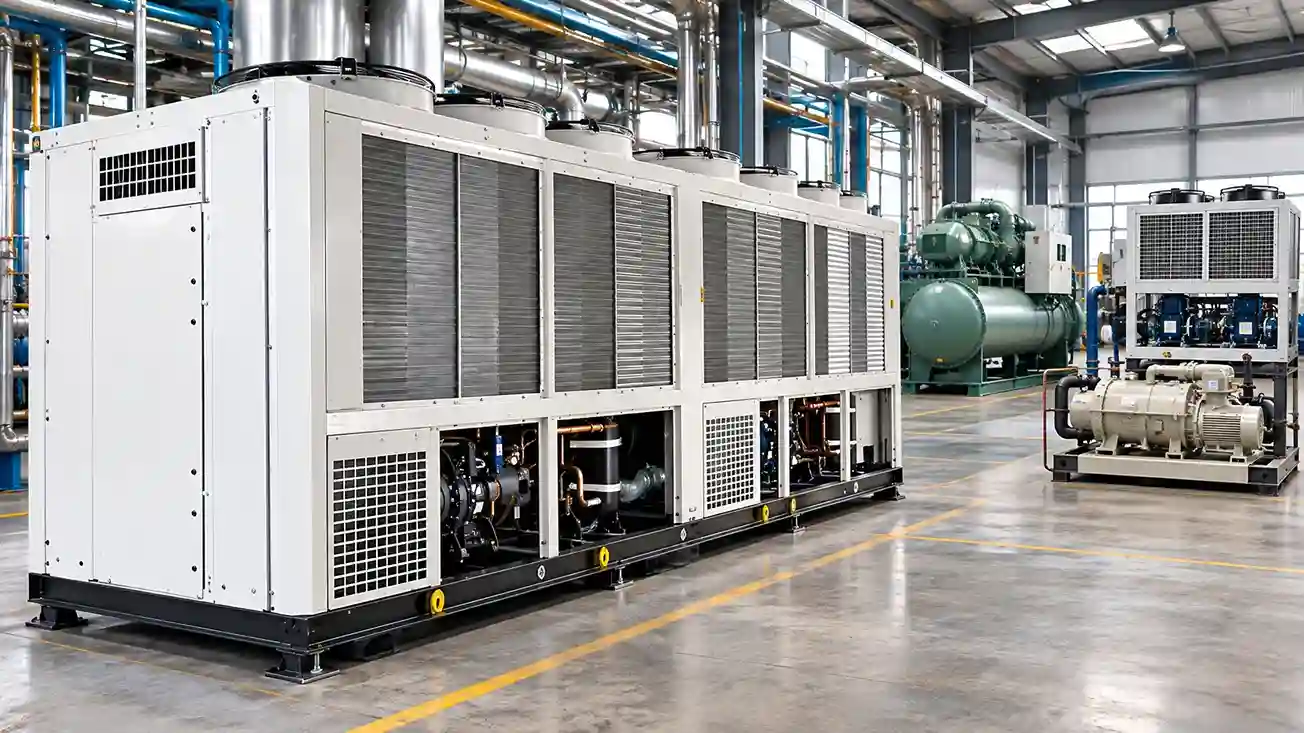
Quick cooling is crucial for efficient industrial plants to ensure quality production and reduce equipment breakdowns, running their equipment 24 x 7. The right industrial chiller can make or break your production as well as your energy bill and operating costs in the long run. However, application specific cooling is not a blanket requirement - screw, scroll, centrifugal and reciprocating chillers are all preferable for individual applications. Read on to understand how.
Screw chiller is an industrial water chiller machine that removes heat with the help of a screw compressor. It's a type of chiller that uses a compressor with two rotors that are twisted together and rotate within the compressor. The refrigerant flows from the condenser to the expansion device. Then comes the evaporator which is where the heat from the process water is transferred to the refrigerant.
Want a cooling solution that packs the punch of high capacity, offers high dependability, and is ready for industrial duty? Your ideal choice is a screw compressor chiller. You can use it in manufacturing plants, chemical factories, pharmaceutical factories, and other industrial occasions.
Choosing screw chiller vs other chillers then you need to think about compressor technologies, cooling capacities, and functions. Screw chillers are suitable for medium to large applications and can have partial load capabilities depending on the design. They usually are used in smaller systems with often more than one compressor to allow for capacity variation.
Whereas, screw chiller vs centrifugal chiller here centrifugal chillers are often preferred when they are suitable for the operating conditions and load profile due to their large capacities. The reciprocating chiller utilises a compression piston and is often used in smaller and more specialised industrial applications.
The primary differences are in capacity, part load characteristics, maintenance, installation conditions and the total operating cost.
| Chiller Type | Typical Application | Key Characteristics |
|---|---|---|
| Screw Chiller | Medium-to-large industrial plants | Flexible capacity and continuous-duty suitability |
| Scroll Chiller | Small-to-medium cooling systems | Compact design and modular configuration |
| Centrifugal Chiller | Large-capacity installations | High-capacity cooling and application-dependent efficiency |
| Reciprocating Chiller | Smaller or specialised systems | Piston-based compression and established technology |
The most appropriate choice will be based on the plant's cooling load, operating hours and lifecycle cost expectations.
Screw chiller applications tend to be for industrial cooling equipment, with scroll chillers being applied to smaller usage needs. Multiple compressors may be used on the scroll in the case of the process, so the choice of one or the other will depend on size of cooling load, hours of operation, plant design and cooling load.
The screw chiller employs twin-screw compression while the centrifugal employs high speed impellers. The centrifugal is generally preferred for large capacity applications. Choosing screw chillers is suitable for many industries with regard to various applications. The actual industrial chiller efficiency is influenced by the power load profile and the temperature requirements.
Rotating helical rotors are the basis of screw chillers, pistons move back and forth in reciprocating chillers. A screw arrangement can be continuous, suitable for industrial processes, while reciprocating machines can be for small or specialised systems. The work involved in maintenance, and its cost, depends on the design, use, and care of the unit.
There are many technical and practical factors to take into consideration when selecting the ideal industrial screw chiller, such as:
Installation space available and ventilation needs also are a factor in equipment choice. Existing water-cooled towers and water systems might lead a plant to choose a water-cooled screw chiller. An air-cooled screw chiller might be better for a plant with a more straightforward outdoor installation.
Other important considerations include:
Screw chiller energy efficiency is not only determined by the screw compressor. Many factors at the system level determine the electricity used and the overall screw chiller operating costs. Part load operation is also critical since industrial plants typically are not running at maximum cooling load all the time.
Compressor control and proper capacity control can enhance operation during off design conditions. Efficiency is also impacted by cleanliness of heat-exchanger, water and refrigerant, flow of water and regular maintenance. For a water cooled system, cooling tower and condenser-water also have to be properly maintained.
When calculating screw chiller operating cost, businesses should consider:
While purchase price is an important consideration, the true costs of that chiller can be better understood by the lifecycle costs. Regular industrial chiller maintenance can also help ensure trouble-free operation and reduce wasted energy.
Every bit as much as the choice of equipment. Buyers should assess screw chiller manufacturers like Aqua Tech Plus based on their skill, quality, and ability to provide service over the years. Before making a purchase, here are some of the factors that need to consider:
Skilled screw chiller suppliers and trustworthy industrial chiller manufacturers like Aqua Tech Plus assist to select the best equipment for your cooling needs.
Deciding on a screw, scroll, centrifugal or reciprocating chiller depends on the cooling needs of your plant. Find equipment with proven capacity, will give consistent results and have operational costs that are not beyond your budget long term. For smooth operations without any major problem choosing best quality equipment from reliable screw chiller manufacturers is important for long term performance.
Aqua Tech Plus can assist you in finding the right industrial cooling systems. For more information on our available solutions, visit or contact Aqua Tech Plus today to know more about screw chiller for your industrial cooling solution.
Here are some of the primary screw chiller benefits that it's designed for medium to large cooling loads in an industrial setting. Its compressor technology, when correctly selected, lends itself to use in continuous-duty applications. Performance and reliability are contingent on design, operation, installation and maintenance.
Not really. Screw chillers might be right for some industrial load profiles; a centrifugal chiller could be used for some large-capacity projects. It will all come down to cooling needs, operating conditions, efficiency at the expected loads, installation needs and lifecycle costs.
Establish the process heat load by taking into account flow rate, specific heat and the temperature differential needed. Precise capacity selection includes an estimate of operating conditions and other heat sources involved. A professional engineering evaluation will determine the most suitable screw chiller capacity.
Review the cooling capacity, energy efficiency, operating temperatures, compressor specifications, ease of maintenance and access, mounting, installation and warranty requirements, and service support. Also consider the screw chiller suppliers’ technical support and spare parts availability.
Aqua Tech Plus provides screw chiller solutions for industrial cooling requirements. Business can contact our team if you require more information on cooling capacities, configuration or application.