
- Home
- About Us
- Chillers
- Industrial RO System
- Projects
- Exhibition
- Certificates
- Infrastructure
- Contact Us
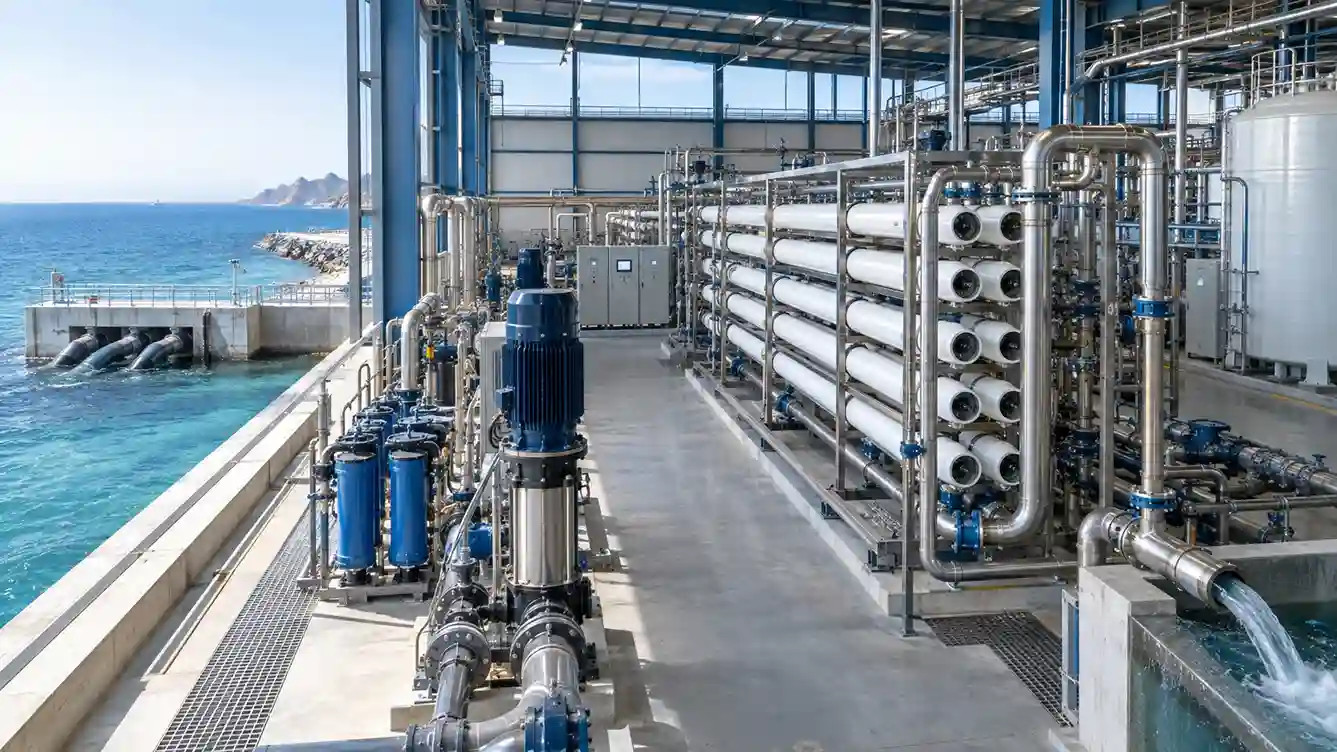
Desalination of sea water is treated for removing all its constituent minerals, salts and all other elements from sea water so as to produce fresh water. It has become popular across coastal areas and various industries due to their limited or un-stable freshwater sources, such as drinking-water sources, industrial processes and other relevant purposes through sea water desalination plant. There are many current methods on water desalination to produce water by some sort of treatment method or another.
SWRO (Seawater Reverse Osmosis) process technology has been the popular method to utilize membranes in high-pressure to separate dissolved salt from sea water efficiently. Therefore, a desalination plants could reliably fulfill our drinking-water needs, industrial production needs etc.
A desalination plants is defined as a water treatment facility where salts, minerals and suspended impurities present in seawater are eliminated to result in useful freshwater, this is performed in a sea water desalination plant. The feed is received in this system and undergoes some treatment processes to remove impurities that are not useful to the utility for producing required quality water through devices such as reverse osmosis.
Desalination units can serve a prominent role in coastal regions to alleviate freshwater shortages. The combined processes include filters, membrane treatment and water conditioning units in a single desalination unit system.
The sea water desalination plant working process involves taking seawater, screening out foreign particles, pretreating to take out suspended solids to prevent blocking the membrane systems. Using advanced methods such as SWRO seawater reverse osmosis, pressurized seawater is forced through a membrane that takes out salts and other dissolved solids to produce permeate water.
Permeate water is then treated to final water quality and stored or distributed to the industry, town or other application to be used, where concentrate is processed in another way. Aqua Tech Plus provides the best quality seawater desalination plant.
The seawater desalination process is drawn from the sea and filtered through screens and meshes of suitable mesh size to exclude any large debris, sand, and any other marine debris and suspended solids, to avoid clogging and damaging to the down-stream equipment and membranes. This helps in preparing the incoming seawater, suitable for subsequent treatment and desalination unit process.
Raw water is conditioned through filtration, chemical treatment, and cartridge filtration processes so that it is suitable for feeding into the SWRO system. The filtration removes suspended solids, microorganisms and other substances which may impact on the membranes' performances, whereas chemical treatment can minimize scaling and fouling of membranes. Seawater pretreatment processes play a vital role in protecting the membranes, increasing efficiency and producing water quality.
When performing SWRO seawater reverse osmosis, water must be pressurized in order to overcome the natural osmotic pressure of the seawater and to pass the water through the semi-permeable membranes. A high pressure RO system provides the necessary pressure for separating the desalinated water from salt and impurities.
A SWRO seawater reverse osmosis (Seawater RO) process is a type of reverse osmosis using a pressurized seawater feed, a semi-permeable membrane that rejects the majority of salts, minerals, and impurities but passes water, and consequently produces two outlets:
There are 2 outputs from a sea water RO plant and they rely on reverse osmosis using membranes.
Beyond the membrane, desalinated water treatment could be subject to remineralization and a pH adjustment in order to bring water in the appropriate condition. A step of disinfection may be applied in order to limit the micro organism multiplication during storage and to distribute water. Treated water is thereafter stored in tanks, either distribution or storage ones. For long-lasting performance choose Aqua Tech Plus.
|
Myth: “Desalination always produces water that is unsafe to drink because it comes from seawater. Fact: Properly designed and operated desalination systems can produce high-quality fresh water. Post-treatment, including remineralization and disinfection, can further condition the water according to its intended use.” |
The processes involved in a seawater desalination plant consist of multiple interconnected systems:
Desalination plants are a stable source of alternative water supply in areas where freshwater availability is limited. Some primary sea water desalination plant benefits include:
| Historic Fact: “Desalination was first widely used in marine and naval settings, helping ships produce fresh water from seawater during long voyages.” |
An industrial desalination plants is used in industries requiring a regular supply of treated water. Here is a list of some desalination unit applications:
Before building a desalination project, evaluate parameters such as below to give a suitable and productive outcome:
The function of a sea water desalination plant with membrane is to remove dissolved salts and other impurities out of seawater, and convert the original sea water into suitable fresh water. The seawater desalination technique based on the principle of the membrane separation forced by driving force, SWRO seawater reverse osmosis is the commonly applied method.
The reliable system working relies on the good design, appropriate pretreatment, and most important selection of the efficient equipment and excellent engineering from Aqua Tech Plusexperienced and leading in the market.
A seawater desalination plant removes salts, minerals, and impurities from seawater to produce usable fresh water, commonly through reverse osmosis.
Reverse osmosis uses pressure to push seawater through semi-permeable membranes that retain dissolved salts and impurities while allowing purified water to pass through.
Feed-water quality, pretreatment, membrane condition, operating pressure, energy efficiency, and regular maintenance can influence overall system performance.
They are used in power plants, refineries, manufacturing facilities, process industries, hotels, and other locations requiring a reliable supply of treated water.
Pretreatment removes suspended solids and other contaminants before membrane filtration, helping reduce fouling and scaling while supporting consistent RO performance.
Aqua Tech Plus can be considered for seawater desalination requirements where properly designed treatment systems are needed. Buyers should review its specific SWRO technologies, capacity options, and engineering support before selecting a solution.