
- Home
- About Us
- Chillers
- Industrial RO System
- Projects
- Exhibition
- Certificates
- Infrastructure
- Contact Us
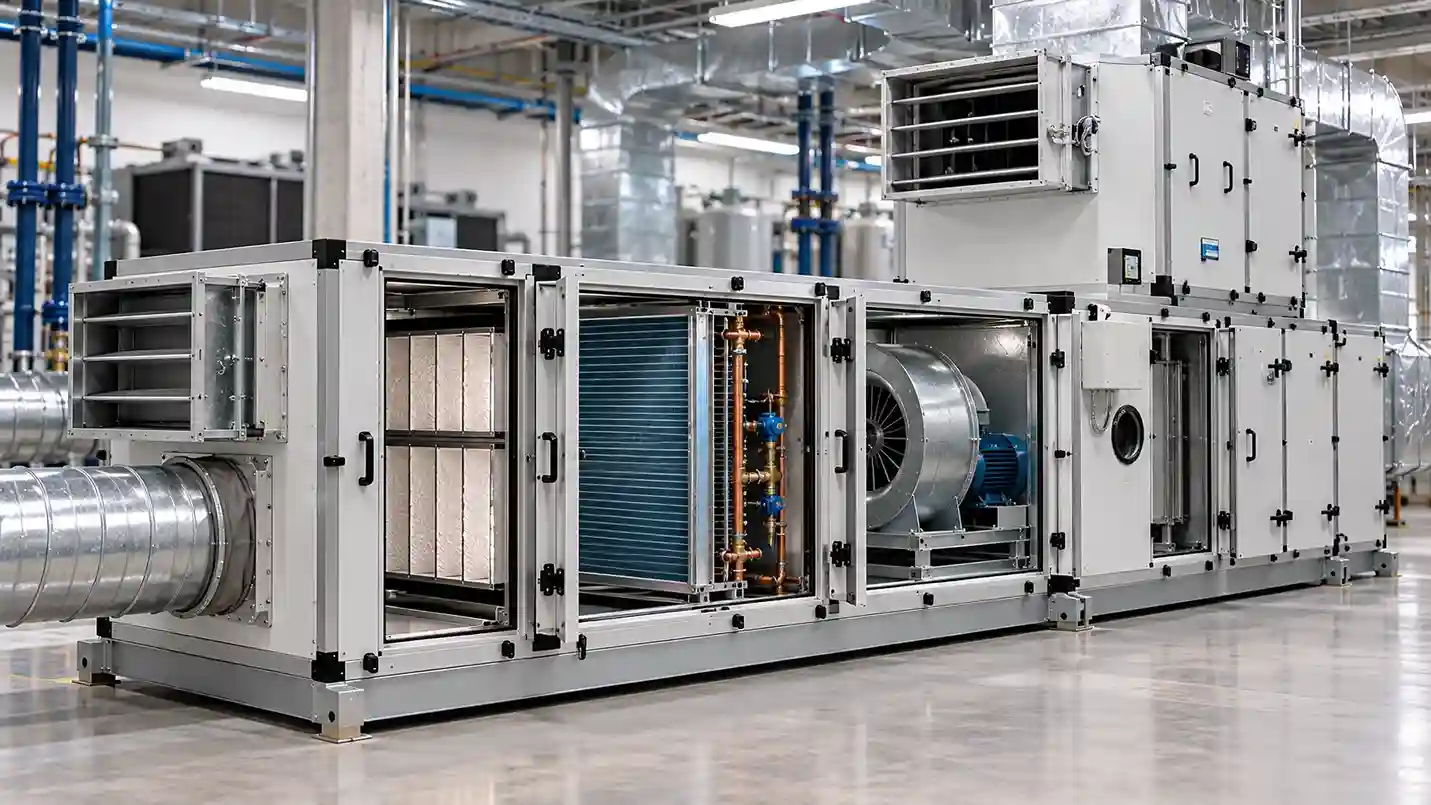
The air handling unit (AHU) is a crucial component in many HVAC systems. It can assist in the transfer, conditioning, filtering, heating, cooling and sometimes control of air prior to its delivery into a building. AHUs vary in size from very small to quite large, depending on the requirements.
What is an AHU? A device employed to condition and distribute air within an HVAC system. Air handling units (AHU) normally intake fresh air, return air or combination of both, condition the air (through filter and coil) and supply as per requirement to a space through an air distribution system ducts. An air handling unit is not a cooling system, but an element that makes up the complete cooling system.
The AHU working principle is dependent on its configuration; however, the basic working process is following a controlled air path. A flow of fresh outdoor air, return air or both flows through dampers into the unit. The air then enters filters which remove the particles at the selected filter level. It can go over cooling/heating coils to adjust the temperature.
The treated air is then drawn into the fan by the fan and sent through the supply ductwork to the building. Operating conditions can be monitored with sensors and components can be adjusted as needed. The sequence depends on the design and use of the AHU.
|
Myth: “An Air Handling Unit is simply a cooling machine. Fact: An AHU does much more than cooling. It can filter and circulate air, regulate temperature, manage fresh and return air, and, when designed with suitable components, support humidity control. Cooling is only one function of an AHU within a complete HVAC system.” |
The type of air handling unit components will vary depending on the building, the air conditioning demand, environmental conditions and the degree of air conditioning treatment. Familiar components are filter, damper, coil, fans, casing and insulation, sensor and controls.
The filter selected depends on the filtration requirements of the application with AHU filters removing airborne particles from the air stream. These AHU dampers may also be utilized to control air flow to ensure the proper operation of the total HVAC system.
When cooling is needed, the temperature of the air passing through the AHU cooling coil is lowered. Coils can either be chilled water or direct-expansion (DX) water, depending on the system. Heating coils are used to increase the temperature of the air when it is necessary to do so; they can be heated by hot water, electricity or other appropriate heat source.
The force pushing air through the unit and ductwork is supplied by an AHU fan. The fan or blower should be chosen based on the airflow, static pressure, operating conditions and system design. Correct selection ensures that the desired air volume is provided in various spaces of the building by the AHU blower.
The AHU casing which encloses and protects all parts inside the AHU is also necessary for inspection and maintenance. Heat transfer may be reduced by using insulation. AHU controls provide monitoring and control of various components (such as fans, dampers and coils) based on system needs.
|
Case Study A commercial building required airflow and temperature control to its many occupied spaces. A multiple zone air handling unit (AHU)-based HVAC system was used. Filters, cooling coils, fans, and controls, designed to meet the building's desired temperature and airflow conditions, were used to condition and serve air to the building. |
Commercial air handling units are suitable for use in offices, hotels, shopping centers, hospitals, and other buildings in which airflow is to be controlled. These are also found in industrial air handling units, pharmaceutical applications and process areas. The amount of filtering, temperature control, air flow and humidity control needed depend on the application and the environment.
| Did You Know? “Did you know that an Air Handling Unit (AHU) can be configured differently for different applications? A commercial building may require basic filtration and temperature control, while hospitals and pharmaceutical facilities can require more specialized filtration, airflow management, and humidity control. This flexibility makes AHUs suitable for a wide range of HVAC applications.” |
Controlled air movement, temperature control and air filtration are the three main AHU benefits:
When AHU selection, look at the airflow, degree of filtering, coil type, available space for installation, noise level, controls, and ease of maintenance. The air handling unit specifications should also correspond to the operating conditions in the building and the needs of the associated HVAC system.
Properly maintained AHU will operate as designed and potential problems will be identified before they affect the operation of the HVAC system. Inspect filters regularly for condition and clean or replace as necessary. Check the cooling and heating coils for dirt accumulation, fans, belts, dampers, bearings, electrical connections, and control sensors should be periodically checked, with drain pans and condensate drain lines also to be kept clear.
Controls and sensors should be inspected and checked. An effective AHU maintenance program should be in place based on hours of operation, conditions, and the manufacturers' instructions.
|
Explore More Insights on related Topic How to Choose the Right HVAC System for Industrial Applications |
Correct size of AHU will ensure that it is delivering the right amount of airflow and temperature control for your application. If the unit is compact and below capacity, the air-handling system of the building may not be provided with the necessary quantity of air. On selecting the size, consider your cooling and heating requirements, air movement quantity, ductwork resistance, filtration needs, operating conditions as well as the location for the setup. Air Handling Unit Manufacturers help shoppers select the appropriate models.
Air handling unit manufacturers like Aqua Tech Plus should be asked the following questions:
An air handling unit is designed to move and condition air in an HVAC system, with the assistance of filters, coils, fans, dampers and controls. The right configuration depends on flow, filter, temperature, space and usage.
No. An AHU primarily handles and distributes air, while an air conditioner is generally designed to provide cooling. An AHU may include cooling components as part of a larger HVAC system.
No. Fresh air AHU intake depends on the system design. Some AHUs handle a mixture of outdoor and return air, while others may be configured differently.
Yes, when suitable components and controls are included. AHU humidity control management may involve cooling coils, humidifiers, dehumidification equipment, or other system components.
AHU filter types vary according to the application and required filtration level. The selection may include different grades of particulate filters based on project requirements.
AHU installation can be planned in plant rooms, rooftops, service areas, or other suitable locations where space, access, structural requirements, and maintenance needs can be accommodated.
AHU maintenance depends on usage and operating conditions. Regular checks generally include filters, coils, fans, dampers, controls, and other components according to the manufacturer's maintenance schedule.
Aqua Tech Plus provides modular and customized air handling units designed according to project requirements. Its AHUs can include filtration, cooling or heating coils, fans, insulation, and control systems based on the application