
- Home
- About Us
- Chillers
- Industrial RO System
- Projects
- Exhibition
- Certificates
- Infrastructure
- Contact Us
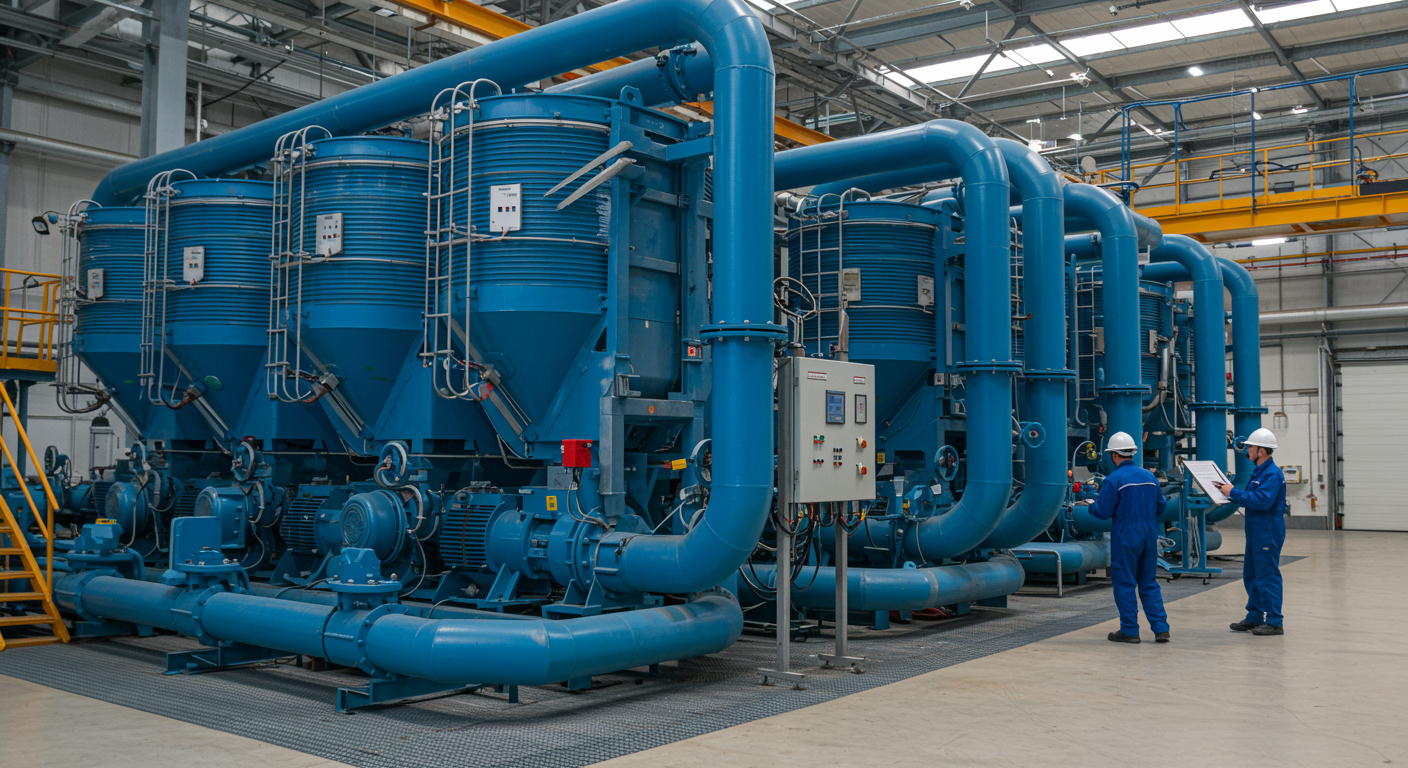
Temperature control has become a necessity in many industries. It affects the quality, safety, and stability of the product. Right from processing plants to food industries, cooling systems have taken the front position. It is here that industrial chillers come into focus. This blog will talk all that you wanted to know about industrial chillers. In this blog, we will explore why industrial chillers are so important—how cooling capacity and COP are measured and how industries can choose the best chillers.
An Industrial Chiller is a cooling system that is manufactured to eliminate heat from industrial equipment and transfer it through water or air. The fluid that gets cooled is then circulated back while at the same time maintaining the desired temperature. Industrial chillers are different from chillers HVAC as the former are used for continuous operation, heavier loads, and demanding tasks. Industrial chillers have a refrigeration cycle that absorbs heat and then transfers it through water or air. After that, the fluid that is cooled is transferred back to the process. This is how one can maintain the desired temperature. Some of the common applications of industrial chillers are plastics, pharmaceuticals, chemicals, power plants, and more.
This table will help make an informed decision if you are planning to invest in industrial chillers soon.
| Specification Category | Common Industry Standard Details |
|---|---|
| Chiller Type | Air-Cooled / Water-Cooled / Glycol / Process Chiller (varies by model) |
| Refrigerant | R22, R407C, R134a, R404A, R410A (depending on model & cooling capacity) |
| Compressor Type | Hermetic Scroll, Semi-Hermetic Screw, Hermetic Rotary, Piston/Scroll combinations |
| Condenser Type | Air-Cooled Finned Coil / Shell & Tube / Tube-in-Shell / Water-Cooled Condenser |
| Evaporator Type | SS Tank with Coil / Shell & Tube / Brazed Plate / Spiral / Straight Tube Array |
| Cooling Capacity Range | <8 kW to 430 kW+ (depending on model size & application) |
| Input Power Requirements | Typically 0.5 kW up to 250 kW+ (3-phase, 380–480 V, 50/60 Hz) |
| Control System | Thermostatic expansion valve / Capillary tube / External balance TXV |
| Water Flow & Pump | Centrifugal pumps with power ratings 0.75 kW to 5.5 kW+ (varies) |
| Pipe Sizes | DN32 to DN80+ (depending on capacity & cooling circuit) |
| Typical Operating Temperature Range | Chilled water output typically ~3–35 °C (customizable) |
| Safety & Protection | High/Low Pressure Switch, Overload, Phase Failure, Flow Protection (varies by OEM) |
Here are some of the reasons why industrial chillers are important:
Since many industrial tasks depend on temperature control, even a slight drift in temperature can affect the output.
One of the most common issues of system failure is overheating. By keeping the machinery within safe limits, industrial water coolers safeguard the machinery.
The cooler the machine, the lower the downtime and the smoother the operation.
Industrial chillers that are used in today’s times are specifically designed to deliver excellent performance while consuming less power. This helps the industries manage the budget.
When heat is removed from a system, the system becomes cooler, and it is known as the cooling capacity of the system. It is measured in either of the following: tons of refrigeration (TR), kilowatts (kW), or BTU/hr.
All these factors are taken care of by trusted Industrial Chiller Manufacturers.
When evaluating the performance of industrial chillers, COP is the most important indicator. COP refers to the coefficient of performance. It measures how effectively the chiller converts electrical energy into cooling input.
COP Formula:
COP = Cooling Output ÷ Power Input
More COP means better efficiency. Many industries prefer chillers with higher COPs, as they result in reduced long-term electricity expenses.
Industrial chiller efficiency does not only depend on COP.
Today, portable chillers are being designed with energy-saving characteristics. This makes them suitable for large-scale and small-scale applications.
Not all industries require the same type of cooling. Some need portable options; others need fixed options.
| Parameter | What It Indicates | Why It Matters |
|---|---|---|
| Cooling Capacity | Heat removal capability | Ensures proper temperature control |
| COP | Energy efficiency | Lower power consumption |
| Power Consumption | Electricity usage | Impacts operating costs |
| Type of Chiller | Air-cooled / Water-cooled | Affects installation & maintenance |
| Application Suitability | Process or comfort cooling | Ensures system compatibility |
This table will give you an idea about various aspects of industrial chillers.
Many buyers might find the initial cost of industrial chillers to be high, but they give an excellent ROI in the future. Here is how they do that:
Businesses should look for the following before investing in an Industrial Water Chiller:
Industrial chillers are important for efficient and safe operations. Before investing in industrial chillers, buyers must look for cooling capacity, COP, and efficiency of the chiller. If you are planning to invest in high-quality industrial chillers, Aquatech Plus is just the platform for you. Apart from industrial chillers, the brand also deals in HVAC systems, bulk milk chillers, water chillers, screw chillers, and more.
An industrial water chiller removes excess heat from machines or processes, maintaining stable temperatures and preventing overheating.
Chillers HVAC are designed mainly for comfort cooling in buildings, while industrial chillers are built for continuous process cooling and higher loads.
COP indicates energy efficiency. A higher COP means lower electricity consumption and reduced operating costs.
Yes, portable chillers are ideal for small-scale operations, temporary setups, or applications requiring flexibility.
Look for manufacturers with industry experience, customization capabilities, reliable service support, and proven efficiency standards