
- Home
- About Us
- Chillers
- Industrial RO System
- Projects
- Exhibition
- Certificates
- Infrastructure
- Contact Us
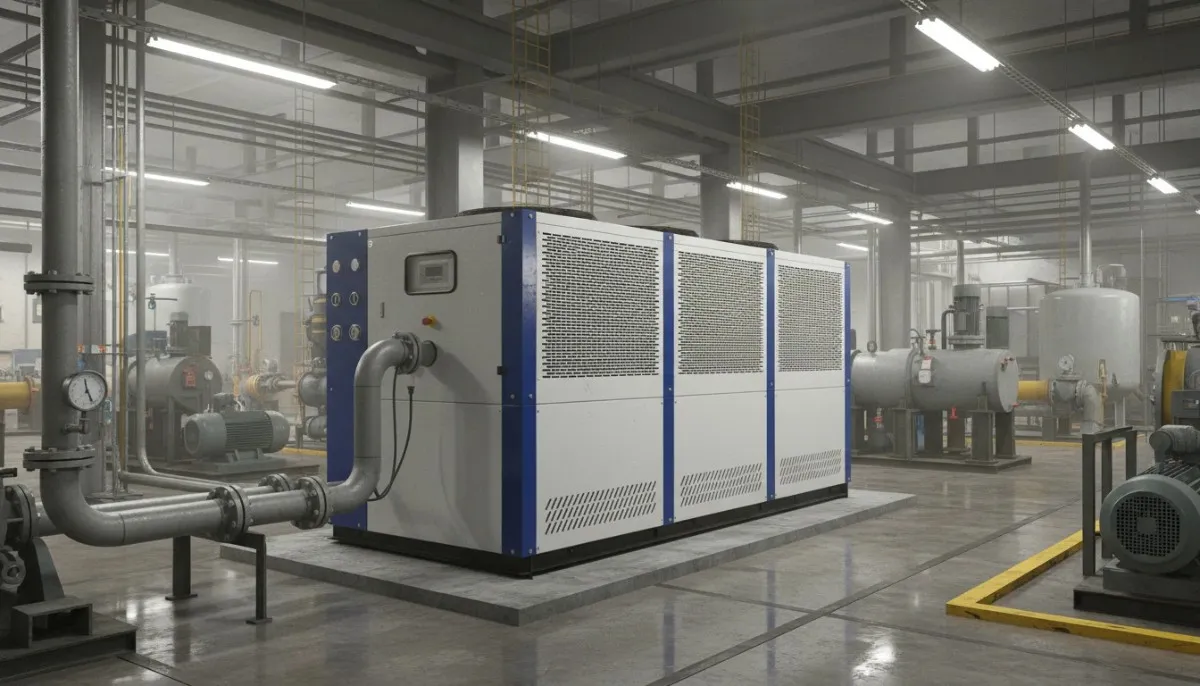
The time taken when milk travels from a dairy farm to a consumer’s breakfast table is crucial. It is a race against time. Raw milk when it comes out of the cow is at a temperature of ~ 37°C (98.6°F). Bacteria can easily breed and multiply at this temperature. In order to stop this, the temperature must be reduced to 4°C as quickly as it can be.
This type of quick cooling can be achieved with one of the latest developments in technology—the glycol chiller system. This blog will talk just about that. We will try to understand the working of this system, what benefits they offer, and why they are better than the traditional water/fluid cooling systems. Towards the end, we will talk about the importance of procuring them from the best Glycol Chiller Manufacturers in India.
A not-so-interesting fact is that bacteria can actually double in number every 20-22 minutes at room temperature. Apart from the taste going bad, this can also result in imposing health risks. All this ultimately results in huge financial losses for the investor. The traditional systems used the ice-water circulation method to cool the milk, but the modern dairy system uses a glycol cooler for “instant cooling." Glycol coolers can further reduce the temperature to sub-zero with the help of a propylene glycol mixture.
Any procurement officer should understand the glycol chiller working principle. This modern cooling system is actually a closed-loop system.
No other country produces milk like India does, making it the no. 1 producer. India tops the list of the world's largest producers of milk. The problem lies in its tropical climate in most of the places. The best glycol chiller manufacturers in India offer chillers that can work even at 50°C. Ganga Metals is one such manufacturer known for its high-quality glycol chillers.
When sourcing a system for a commercial dairy or export-oriented unit, the hardware must meet rigorous hygiene and performance standards. Below is the comprehensive technical breakdown used by top-tier manufacturers.
| Section | Parameter | Detailed Specifications & Export Standards |
|---|---|---|
| Performance | Cooling Capacity | 1 TR to 200 TR (Available in Single & Multi-circuit) |
| Temperature Range | As per application (Sub-zero to +15°C outlet) | |
| Ambient Condition | Tropicalized design for peak performance at 50°C | |
| Fluid Medium | Water + Food Grade Propylene Glycol (20% to 50%) | |
| Refrigeration | Compressor Brand | Copeland (Emerson), Danfoss, or Bitzer |
| Compressor Type | High-efficiency hermetic scroll or semi-hermetic screw | |
| Refrigerant Gas | Eco-friendly R404A, R407C, R410A, or R134a | |
| Condenser Type | Air-cooled (Cu-Al Blue Fins) or water-cooled (Shell & Tube) | |
| Expansion Valve | Emerson or Danfoss thermostatic / electronic valves | |
| Hydraulics | Process Pump | Stainless Steel (SS-304 / SS-316) monoblock centrifugal |
| Water Tank | SS-304 grade, argon welded, with 25 mm PU insulation | |
| Plumbing | Heavy-duty copper / SS piping with vibration eliminators | |
| Electricals | Control Panel | Microprocessor-based PID or PLC with HMI interface |
| Switchgear | Schneider, Siemens, or ABB (Global serviceability) | |
| Power Supply | Customized 380V–415V / 50Hz or 460V–480V / 60Hz | |
| Protection | High / low pressure, phase sequence, flow switch, overload | |
| Safety Systems | Alarms | Audio-visual alarms for low fluid level & temperature deviation |
| Internal Layer | VCI anti-corrosion film & heavy-duty stretch wrap | |
| Packaging | External Layer | ISPM-15 certified plywood box (fumigated for customs) |
| Base | Steel-reinforced wooden pallet with 4-way forklift entry | |
| Logistics | HS Code | 84186990 (Industrial cooling equipment) |
| Export Port | Nhava Sheva (Mumbai) / Mundra / Pipavav – India | |
| Documentation | QC report, wiring diagram, certificate of origin & CE manual |
If you are a dairy owner or a procurement manager, the first thing that comes to mind is the glycol chiller price. It is a bit higher than the traditional cooling systems, but ROI, i.e., the return on investment, is based on the following three factors:
In India, a high-quality 1-ton glycol chiller might range from ₹1,25,000 to ₹700,000 (10 TR to 40 TR). This price is completely dependent on the chiller’s capacity and your industrial requirement.
In the dairy industry, one size of chiller is not suitable for every cooling task. When connecting with leading glycol chiller manufacturers in India, you should take care of the following:
Confirm your requirement. You should know the amount of milk you deal with on an everyday basis. Only then should you decide on the type of chiller you want to invest in.
Food-grade requirements must be taken very seriously. Only propylene glycol is used in the chiller as the refrigerant. Other types may be toxic.
Since Glycol Chillers are expensive equipment, they should at least work efficiently for 12-15 years. Here are some maintenance tips.
By understanding your requirements and by choosing glycol chillers with the required specifications, you can ensure that milk remains fresh, does not taste bad, and has no bacterial growth. Invest in high-quality glycol chillers; connect with Aqua Tech Plus today. They are the leading glycol chiller manufacturers in India.
By mixing glycol with water, the freezing point of the coolant is lowered to sub-zero. This allows the system to circulate a much colder fluid than standard water, pulling the heat out faster than traditional ice-water methods.
Propylene glycol is food-grade and non-toxic. In dairy production, this is a safety requirement; if a leak occurs in the heat exchanger, it wont contaminate the milk with toxic chemicals, unlike industrial-grade ethylene glycol.
Yes. High-quality Indian chillers are "tropicalized," meaning they are engineered with heavy-duty condensers and high-efficiency compressors designed to maintain full cooling capacity even when outdoor ambient temperatures hit high temperatures.
A concentration of 20% to 50% is standard. Too little glycol risks the evaporator freezing and cracking, while too much makes the fluid too thick (viscous), which reduces cooling efficiency and puts stress on the pump.
Absolutely. The ROI comes from zero milk spoilage, significantly lower electricity bills due to modern compressor technology, and better milk quality (higher cream content), which allows for premium pricing.
While you should monitor pump readings daily, a professional service should be done quarterly. This involves checking glycol pH levels, cleaning condenser fins to prevent compressor strain, and inspecting electrical switchgear.