
- Home
- About Us
- Chillers
- Industrial RO System
- Projects
- Exhibition
- Certificates
- Infrastructure
- Contact Us
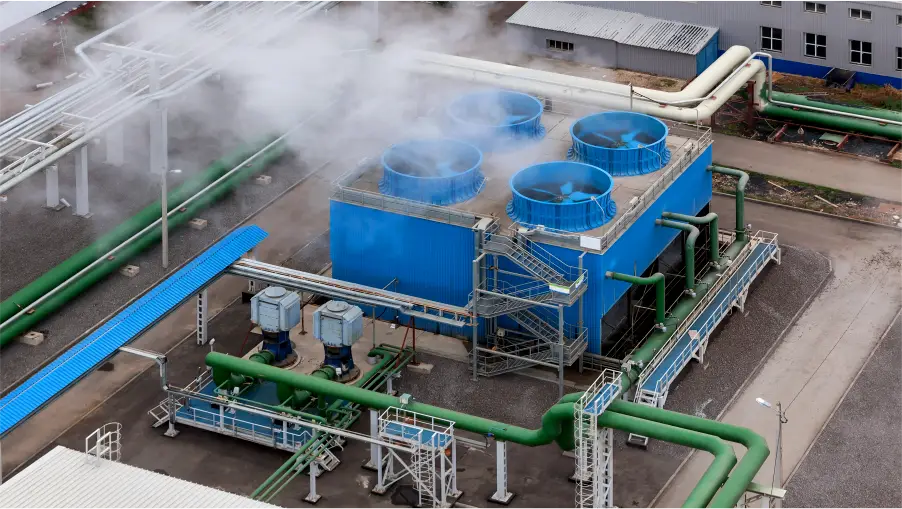
Chillers are applied in the air-conditioning systems as well as industrial plants and large commercial buildings where cooling is not controlled . These are the simple functions of them; they heat water and provide the cooled water to machines or air-handling units or production processes. This is not as easy as it may seem because the operation of a chiller is largely determined by what occurs within the system.
Each chiller has a refrigerant gas at its centres. This gas absorbs heat in the water and passes it through the system to the outside. When the refrigerant is not the right one, the chiller will either use more energy, work in an unsafe way, or not fit the environmental requirements.
The gases that are applied in chillers have varied over the years. Productivity requires more. The level of safety expectations increased. The environmental regulations were also taken seriously. Due to this, the industry was slowly shifting towards newer and cleaner refrigerants as opposed to the old ones.
The majority of chillers are based on the vapor compression principle. It is a technical concept, and the process is more or less straightforward.
The refrigerant passes continuously on the evaporator, compressor, condenser and expansion device. The refrigerant also takes the heat out of the chilled water inside the evaporator and transforms into a low-pressure gas. The actual cooling process occurs here.
This gas is in turn drawn in by the compressor which raises its pressure and heat. The hot refrigerant gas is then directed to the condenser after being compressed. In this case, it gives heat to air or cooling water and condenses again to become a liquid. The expansion device gets its pressure lowered and then it is pumped back in the evaporator and the process goes on.
The efficiency of this cycle is determined by physical and chemical properties of the refrigerant. Factors such as Boiling temperature, operating pressure, heat transfer possibility, stability and safety are also important.
Most chillers are on the vapor compression principle. It is a technical concept and the process is more or less straightforward.
The refrigerant circulates continuously on the evaporator, compressor, condenser and the expansion device. The refrigerant also removes the heat in the cooled water in the evaporator and it is converted into a low pressure gas. The cooling process actually takes place here.
The compressor in turn draws this gas into it increasing its pressure and heat. The compressed hot refrigerant gas is then channeled to the condenser. In this instance, it warms air or cooling water and condenses once more to form a liquid. This is done by decreasing the pressure of expansion device and pumping back in the evaporator and the process continues.
Physical and chemical properties of refrigerant determine the efficiency of this cycle. Others include Boiling temperature, operating pressure, heat transfer possibility, stability and safety.
R-134a has become popular as a replacement of older CFC refrigerants used by manufacturers. It was selected by engineers due to its non-flammability, stability, and relative safety, which make it applicable in a wide range of commercial chillers.
Neither does it harm the ozone layer which was a big advantage back then. Nevertheless, R-134a is highly potent in global warming and tougher environmental restrictions grew up to be serious issues in the future.
R-410A is a high-pressure refrigerant widely used in modern air-conditioning equipment and compact chillers. It provides strong cooling performance and supports compact system design.
Because of its pressure characteristics, equipment using R-410A is designed differently from older systems. When used correctly, it delivers good efficiency and reliable operation.
The issue with R-410A is not performance but environmental impact. Like many HFC refrigerants, it has a high global warming potential. As a result, its use is being restricted in many regions, especially for new installations.
R-22 which is currently prohibited or severely restricted worldwide was replaced by R-407C. Its behavior is comparable to R-22, hence it was effective to use to retrofit existing systems.
It is widely applied in medium-capacity chillers and is stable in operation. Nevertheless, R-407C is also a high global warmer. This restricts its adoption in the long run concerning the existing and future environmental policies.
As environmental rules became stricter, the industry began focusing on refrigerants with lower global warming potential. This led to the development of new blends and HFO-based refrigerants.
R-513A is a substitute of R-134a in most chiller applications. Its performance and operating pressure are near to the R-134a which is easily converted to the system.
Simultaneously, its effect on global warming is considerably low. It is combustible free and can be used in most of the existing chiller designs and therefore can be used in new installations as well as retrofit projects.
These refrigerants are primarily applicable to big centrifugal chillers. They are characterized by extremely low global warming capacity and no ozone depletion.
Their nature of pressure and temperature are not similar to traditional refrigerants and therefore they need systems designed to fit them. Despite this requirement, they are finding their way into modern high-performance chillers due to their ability to sustain performance-as well as environmental objectives.
Not all chillers rely on mechanical compression. Absorption chillers use a different approach, where heat energy replaces the compressor.
In water–lithium bromide systems, water itself acts as the refrigerant. Under low pressure, water evaporates and absorbs heat from the chilled water circuit. The vapor is then absorbed by lithium bromide and later separated again using heat.
Such systems are ecologically friendly since water contains no ozone depleting and no global warming characteristics. But they can only be applied in the case that chilled water temperatures should be over freezing and that there should be some heat source like steam or waste heat.
Ammonia and water are the refrigerant and absorbent respectively as ammonia-water absorption systems. These systems are capable of even lowering the temperatures and are employed in certain industrial cooling and refrigeration purposes.
Glycol is also referred to in connection with chillers, however, this is not a refrigerant gas. Rather, it is a support in the system. To avoid freezing, engineers add ethylene glycol or propylene glycol to the chilled water, particularly in low temperature applications or cold climates.
Meanwhile the refrigerant gas does the actual cooling in the chiller. The glycol- water mixture is then safely transported to locations where it is required by carrying this cooling through pipes, coils and heat exchangers.
International treaties such as the Montreal Protocol and the Kigali Amendment have altered how the cooling industry selects and utilizes the refrigerants. These regulations initially eliminated refrigerants that harm the ozone layer, and in the current scenario they are cutting down on the consumption of gases leading to high global warming.
Due to this, there has been an improvement in chiller design, safety regulations and energy efficiency. Nowadays, producers are working on the natural refrigerants, low-GWP and smarter system design to provide high performance and a greener environment.
Various gases are available but the choice that will be used in chillers to cool depends on the capacity of the system, the form of use, safety aspects and the environmental policies.
Ammonia, R-134a, R-410A and R-407C are the refrigerants which have played a major role in the chiller technology. At the same time, the future is also being determined by such newer options as R-513A, R-1234ze, and R-1233zd. In situations that are favourable to absorption chillers, water is the refrigerant itself. The choice of the appropriate refrigerant does not involve marketing or trends.
Refrigerant gases that are used in water chillers include Ammonia (R-717), R-134a, R-410A and R-407C. As the modern chillers stabilize, there is a significant use of low-GWI refrigerant such as R-513A, R-1234ze, and R-1233zd in an effort to comply with environmental laws. This decision is based on the size of the system, application and the safety requirements.
Ammonia is employed in industrial chillers due to its high cooling efficiency, good heat transfer capabilities as well as zero global warming capabilities. It suits well on large capacity systems like cold storage and process cooling. Nevertheless, it is toxic and thus needs to be handled by trained people and with high standards of safety.
The contemporary eco-friendly chillers incorporate low-GWP refrigerants including R-513A, R-1234ze and R-1233zd. These gases offer efficient cooling and offer a great deal of cooling to the environment. These are typically utilized in new commercial and centrifugal chiller systems.
No, absorption (chillers) do not involve the use of traditional refrigerant gases. Rather, water is used as the refrigerant and lithium bromide or ammonia is applied as the absorbent. These chillers require heat energy rather than compressors thus suitable when the source of heat is waste or steam in nature.